
Publisher Description
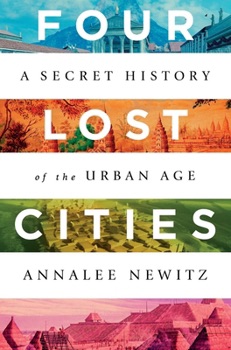
In Four Lost Cities, acclaimed science journalist Annalee Newitz takes readers on an entertaining and mind-bending adventure into the deep history of urban life. Investigating across the centuries and around the world, Newitz explores the rise and fall of four ancient cities, each the center of a sophisticated civilization: the Neolithic site of Çatalhöyük in Central Turkey, the Roman vacation town of Pompeii on Italy’s southern coast, the medieval megacity of Angkor in Cambodia, and the indigenous metropolis Cahokia, which stood beside the Mississippi River where East St. Louis is today.
Newitz travels to all four sites and investigates the cutting-edge research in archaeology, revealing the mix of environmental changes and political turmoil that doomed these ancient settlements. Tracing the early development of urban planning, Newitz also introduces us to the often anonymous workers–slaves, women, immigrants, and manual laborers–who built these cities and created monuments that lasted millennia.
Four Lost Cities is a journey into the forgotten past, but, foreseeing a future in which the majority of people on Earth will be living in cities, it may also reveal something of our own fate.
My Thoughts
This is a bit of a departure in my typical reading, but I picked this up after an enthusiastic recommendation from Stephanie Cole Adams, someone whose opinion I greatly respect. I found an accessible, thought-provoking, and sometimes irritating look at ancient urban development and why it failed at four specific sites.
The format of the book – essentially four long sections each devoted to one city – makes this a comfortable read and easy to start and stop. However, I often found it hard to stop reading.
Netwitz explores each city in person and through scientific experts, which lends a familiarity to the narrative. For the non-scientific reader, it feels like an enthusiastic friend touring you through a new city sharing interesting bits of information. I understand that for the scientific reader this is an irritating approach, but for me it was just right.
A number of reviews mention the author’s interjection of their personal belief system and exposition of conjecture as fact as a major issue here. I suppose that’s true, but that’s how connections are made for many readers. I found their personal reactions and use of imagination entertaining and thought-provoking, and something that I believe is often missing in the cold, hard facts of scientific research. I *want* to imagine the daily life of the inhabitants of these cities, and Newitz does a good job of humanizing the people who lived, farmed, labored, and died in each location.
I found the section on Pompeii especially interesting as I had the most knowledge about this city prior to reading the book, but I learned something new about each city. Pompeii, though, seemed like the Las Vegas of Ancient Rome, something I didn’t really understand before reading this book.
I’d recommend this for the casual non-fiction reader with an interest in urban development and ancient history.
Publication Date: February 2021
Published By: W.W. Norton & Company
Thanks to the Monroe County Library System for the book

 It's All About the Book