100 Books. 100 Years

100 Years. 100 Books – #15, 1928


A Mirror For Witches by Esther Forbes – I knew Forbes primarily from her Newbery winning novel for children, Johnny Tremain, so I was eager to read this book, which recounts the hysteria of the Salem Witch Trials decades before Arthur Miller’s The Crucible.

The book opens with Captain Bilby, an English merchant captain, rescuing a wild, goblin child from the scene of a horrific witch burning in France. He calls the child “Doll” because she reminds him of such a poppet, with her wild hair and button eyes. Doll, a child of 7 or 8, witnesses both of her parents being burned as witches, a trauma which shapes the rest of her life. Bilby’s wife is none to pleased when he returns to England with this odd, silent child. Eventually, the family makes its way to the Massachusetts colony, where Doll grows to womanhood never gaining the trust or love of her new mother.

Eventually, Doll attracts the attentions of  the son of a neighboring farmer, who finds himself attracted to her. The fathers agree this is a good match that will unite their farms and families. However, Goodwife Bilby accuses the girl of witchcraft, indeed has harbored the idea from the time the girl was brought into her home. The hysteria happening in Salem, located just a town away, seeps into the psyche of Cowan’s Corners, where Doll is accused of all sorts of evil doings.

Written decades before The Crucible, Forbes’ story of the Salem trials is told from a woman’s point of view, where sexual attraction and desire is looked on as devilment and the work of a witch, rather than as a natural human emotion. Forbes’ treatment of this dark chapter in American history is thoughtful, eloquent and horrifying at the same time.

I was able to find a copy of the 2006 reproduction printing of this book, done in authentic typesetting and accompanied by noteworthy woodcuts by Robert Gibbings. If you are fascinated by the hysteria that swept Salem in the 1600s, or if you are looking for a slice of women’s history, try this one. You won’t be sorry.

5 out of 5 catalog cards

100 Books. 100 Years

100 Years. 100 Books – #14 1927


The Tower Treasure by Franklin W. Dixon – I had to read this for 1927 given the fact that I vividly recall trying to read every Hardy Boys and Nancy Drew mystery published when I was a kid. The Tower Treasure was the first Hardy Boys mystery published and set the stage for the multitude of teen-based mystery serials that followed.

In The Tower Treasure, Frank and Joe become involved in a rash of robberies in their hometown, Bayport, one of which involves their best chum, Chet Morton. Frank and Joe are just getting their detective chops here, wanting desperately to be just like their Dad, the renowned detective and former NYC police officer, Fenton Hardy. The boys follow clue after clue while searching for the culprit who swiped a treasure in jewels and stocks from the local rick folk, the Applegates, who live at The Tower Mansion. Along the way, several chums help out, the boys frustrate the efforts of an inept detective wannabe, Oscar Smuff, and eventually find their way to the treasure, only to narrowly escape certain death, or at least a little discomfort when a nasty looking hobo locks them in a water tower.

The Hardy Boys is just one series written by the publishing group known as the Stratemeyer Syndicate, founded by Edward Stratemyer. This group was the first publishing unit known to direct its work at children, and its progeny include the Hardys, Nancy Drew, The Dana Girls, Tom Swift, The Rover Boys, and The Bobbsey Twins.

Re-reading this book after so many years was somewhat of a silly treat. The plot and the writing is very simplistic, and the good luck and coincidences experienced by the boys are almost too much to believe. However, for children reading this in the 20’s, 30’s and even into the 60’s and 70’s, the Hardys were It. Every boy wanted to ride motorcycles like Frank and Joe, and every girl wanted to be Callie (Frank’s sweetheart), or Iola (Joe’s girl).

If you were a Hardy fan in childhood, re-read a few of the original books for a quite afternoon reminiscing on the early days of your mystery reading when there were few corpses and certainly no serial killers.

5 out of 5 catalog cards for old time’s sake….

100 Books. 100 Years

100 Years. 100 Books. #13– 1947 (1913)


Carnacki the Ghost Finder by William Hope Hodgson

True, the original Carnacki collection was published in 1913, but it was re-issued in 1947 and created a stir in a world recovering from the horror or human war. The character of Carnacki is a cross between Sherlock Holmes and VanHelsing, a man who uses intellect and science to battle forces of darkness. I’m betting Carnacki was also the model for one of my all-time favorite TV shows, the 1970’s classic The Night Stalker, starring the magnificent Darren McGavin as Karl Kolchak.

This collection of short stories follows the adventures of Carnacki, a ghost finder, who is called in to investigate all sorts of supernatural goings on, usually in the English countryside. The stories are told to a group of Carnacki’s friends as they gather for dinner at his home. In each story, Carnacki approaches the supernatural activity with a healthy dose of skepticism tempered by a real belief in the unknown, a bag full of equipment, and his trusty camera. Through the course of these stories, Carnacki battles a huge hand, an enormous pair of lips that whistle a horrifying tune, and a group of very human smugglers “haunting” a castle, among others.

I was reminded of the old pulp comics while reading this one, and I bet I could find a Carnacki comic if I looked hard enough. This is an entertaining, light read for fans of the horror genre. Not terribly gruesome but certainly very spooky and lots of fun.

5 out of 5 catalog cards.

100 Books. 100 Years

100 Years. 100 Books. #12 – 1920


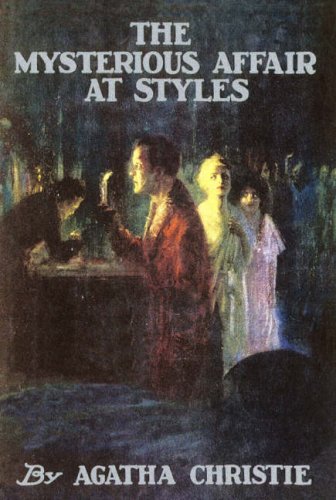
The Mysterious Affair at Styles by Agatha Christie

Those of you who know me, know very well that I am a diehard mystery fan, and as such, completely revere the great Agatha Christie. Several years ago, my father-in-law, who is an addicted garage sale junkie, showed up at my house with a box full of an entire set of Agatha Christie books. These weren’t your every day, average books – these were a Set, with black leather bindings, and gold leaf edges. And they had never been cracked.

Although it killed me to be the first to open these beautiful books, books are, after all, meant to be read. So I started re-reading all the Christie’s I’d devoured as a kid, and found several I’d never read. One of those was The Mysterious Affair at Styles, originally published in 1920. Even though I’d read it before, I felt obliged as part of this reading project to read and write about Christie’s first published novel and the first appearance of Hercule Poirot.

As the story opens, we meet Lieutenant Hastings, freshly returned from war and recuperating from a wound. He meets up with old friend John Cavendish, who invites Hastings to spend some time at his family seat, Styles, as he begins his rehabilitation. The family home, owned by John’s stepmother, becomes the scene of a murder involving the family matriarch, Emily Inglethorp. As the local police struggle with the crime, Hastings brings in an old acquaintance, Hercule Poirot, the Belgian detective who became one of Christie’s most famous characters. Poirot and Hastings, along with Inspector Japp who also appears in later Poirot mysteries, engage the characters, discover and refute alibis and motives, and eventually, through the use of Poirot’s famous “little grey cells,” unmask the murderers.

Although Christie’s first published story, The Mysterious Affair at Styles was greeted with great enthusiasm by critics and readers alike when it was published in the United States in 1920. This marked the beginning of an illustrious career for Christie and the development of a genre that has become beloved by millions of readers worldwide. If you haven’t read The Mysterious Affair at Styles lately, or at all, find yourself a copy and settle in for a treat.

5 out of 5 catalog cards.

100 Books. 100 Years

100 Years. 100 Books. #11 – 1919


The League of the Scarlet Pimpernel by Baroness Orczy

I have fond memories of reading the book to which this one is a sequel – The Scarlet Pimpernel – one hot summer in between high school semesters. I was reading anything I could find about the French Revolution, and a librarian at the Gates Library recommended Baroness Orczy and the Pimpernel, which I devoured.

I had not realized there was a sequel until I started creating the lists for this reading project, and was delighted to find my old friend Percy Blakeney among the choices. In fact, I discovered there are a great many sequels to the original Pimpernel, which I’m sure will lead to much more reading for me!

The League of the Scarlet Pimpernel picks up with Sir Percy still rescuing unfortunate maidens and righting wrongs in post Revolution France, albeit in a collection of short stories instead of one longer novel. Each vignette has Percy or another member of The League righting wrongs committed against members the aristocracy or members of their staff. Children are rescued, fortunes restored, and lives set aright, all at the hand of the man with the twinkling blue eyes that can turn to steel in a second.

An entertaining read for fans of the spy genre and historical fiction.

4 out of 5 catalog cards.

100 Books. 100 Years

100 Years. 100 Books. #10 – 1917


Daughter of the Morning by Zona Gale

I was eager to read this story because I had was intrigued by a biographical sketch of Zona Gale’s I’d found in a reference book in the Central Literature Division. Gale was an early proponent of rights for women, participating in the National Women’s Party and the Lucy Stone League, and specialized in writing about strong women who overcame traditional roles and made their own opportunities.

Daughter of the Morning is an example of Gale’s descriptive writing about the lack of opportunities afforded to women in the early 20th century. The story opens with Cossy, a young woman just out of teens and stuck living on a farm with her parents and brothers, who all seem unhappy with their lot in life. She’s creating a book out of wrapping paper, someplace she can write down her thoughts. Cossy frets about what to do with her life. She has no particular ambition, except not to turn out like her mother and father, who scream at each other constantly. In the opening chapters, she reluctantly agrees to marry Luke, a neighbor who says “she’s got to marry somebody” and why not him?

The morning after she agrees to marry Luke, she meets a stranger on the road as she’s walking at dawn, enjoying her solitude. That meeting opens a whole new world of ideas to Cossy, who within the day, has decided to leave the farm and move to the city to find her way. She eventually finds a job in a factory, where she becomes involved with workers rights. The story is a string of adventures experienced by Cossy in the big city, which all lead back to the farm and home.

What I find particularly interesting about the women’s fiction of this time period is the reach into independent living, which fires much of this story, but the eventual return to the status quo of the male hero “rescuing” the female protagonist in the final chapter by clasping her tightly to his broad chest and declaring that he has been hopelessly in love with her for the whole book and won’t she please marry him and make his life complete? Not unlike a Harlequin romance novel of today.

Daughter of the Morning is at best a pleasant if uninspiring read.

3 out of 5 catalog cards

100 Books. 100 Years

100 Years. 100 Books #9 – 1916


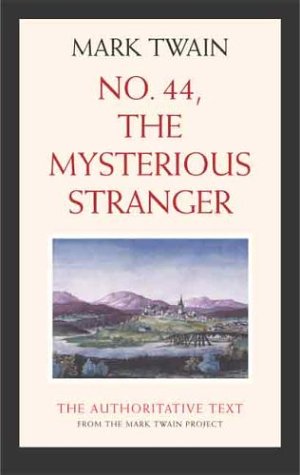
The Mysterious Stranger by Mark Twain

I picked this story for 1916 primarily because it was a work by Twain I did not know and I was curious. This is one instance when it would have been better to leave my curiosity unsatisfied. 

During the last part of his life, Twain entertained a great fascination with what he referred to as the “hypocrisy of religion. ” This edition of The Mysterious Stranger concentrates on that, telling the rather jumpy story of the “mysterious stranger,” Satan, the unspoiled nephew and namesake of the Lord of Hell. The story begins in the hills of Austria, set during the Middle Ages, and concentrates on the actions of Satan as he befriends a group of young boys, who are both horrified and delighted at the attention paid them by the stranger. 

The story jumps around and rambles, and so lost me about a third of the way in. The forward says this edition is a compilation of two versions of the manuscript, which Twain worked on sporadically from around 1890 to 1910, and which was left unfinished when Twain died. 

Unfinished, rambling, preachy, and just plain uninteresting, skip this one. 

1 out of 5 catalog cards.

100 Books. 100 Years

100 Years. 100 Books #8 – 1914


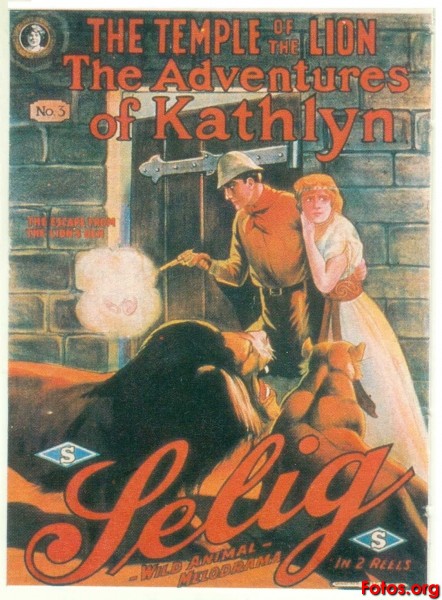
The Adventures of Kathlyn by Harold McGrath

 Picture the old silent films with the evil villain menacing the innocent, goddess-like heroine, who is saved either through her own ingenuity or by the handsome hero…again, and again, and again. All of those films were born out of this story. 

The Adventures of Kathlyn was actually published to coincide with the release of the film of the same name, which is acknowledged as the second serial ever made in American cinema and the first of the cliffhanger genre. 

Kathlyn Hare is the beautiful blonde daughter of adventurer Colonel Hare, who inherits the throne of a tiny Indian kingdom after saving the King from being mauled to death by a big cat. We first meet Kathlyn as she is sculpting a leopard on her father’s ranch in sunny California. Kathlyn has an uncanny way with animals and is able to calm the fiercest of wild beasts with a few quiet, sweet words, a long look and a gentle touch. The first “dog whisperer” perhaps?

 Colonel Hare unexpectedly departs on a mysterious journey back to India, leaving a letter for Kathlyn and her sister to open on New Years Eve if they fail to hear from him again. Unbeknownst to Kathlyn, her father’s letter is replaced with one written by the dangerous pretender to the throne, Umballa, who wants to lure Kathlyn to India in order to marry her and seize the throne.

On the way to India, Kathlyn makes the acquaintance of the handsome, stoic John Bruce, a big game hunter who knows her father. She does not reveal her identity because she wants to rescue her father without assistance from anyone. Little does she know that Bruce will be her rescuer again and again. As soon as she arrives in India, she begins falling into and out of Umballa’s clutches. After many narrow escapes, all’s well that ends well.

 As with much American writing of this time period, The Adventures of Kathlyn is shot through with stereotypes, classism and racism, reflective of the culture in the early 20th century. The stereotypical fair skinned, blonde woman being lusted after by the dark-skinned foreigner; the strong, silent hunter-hero; the doting father; silly younger sister; there are too many to count in this story. The story was clearly developed to leave the audience hanging at the end of each section, and it accomplishes that task admirably. Kathlyn is shot and tumbles into the river; Kathlyn is menaced by a ferocious lion; Kathlyn is about to be whipped within an inch of her life…and so on. You can just picture the film scenes.

If you are a fan of early cinema and want to sample the writing behind the film, give this one a try. If you enjoy series fiction, you will also probably like Kathlyn. She’s a little bit of Nancy Drew, Buffy and Lara Croft all rolled into one. I hope The Adventures of Kathlyn is on DVD, because I would dearly love to watch a few of the episodes. I suspect they’ll be as corny as the written version but more fun.

3 out of 5 catalog cards.

100 Books. 100 Years

100 Years. 100 Books #7 – 1912


The Room in the Tower by E.F. Benson

In high school, I went on a bender for vintage ghost stories, primarily due to MaryAnn Satter, my English teacher at Nazareth Academy who also loved a good ghost story. She introduced me to authors such as J. Sheridan LeFanu, Ambrose Bierce, Edgar Allan Poe, Algernon Blackwood, and E.F. Benson. When I came across The Room in the Tower by Benson in my search for a title published in 1912, I was reminded of the fierce and cold terror many of these authors wrote into their stories and decided I had found my entry of 1912.

The Room in the Tower is a short story, but it packs a whole lot of terror into a few pages. The narrator describes a terrifying recurring dream he’s had for years, where he finds himself at a lovely country home with an old school acquaintance and his family. The dream begins with tea or some sort of gathering with all the guests and family, and invariably ends with the hostess, Mrs. Stone, getting up and telling the narrator “Jack will show you your room. I have given you the room in the tower.” Those words start the shivers up the narrator’s spine, which only worsen as he follows Jack up the stairs to the room in the tower. The dream ends as the door is closed and locked behind the narrator.

The dreams recur until the day he finds himself face to face, in real life, with the tower and the country home. As in the dream, he is led up the stairs to the room in the tower, where he and his friend find comfortable lodgings, with the exception of a creepy looking portrait of Julia Stone, the former owner of the property. The portrait is removed and carried to the hall, where both men find their hands covered in blood. That night, the narrator is awakened by a horror too awful to comprehend, Julia Stone come back from the grave.

I know this sounds like a typical ghost story, but what I always found unique about Benson’s writing is how he was able to build that swell of terror while describing ordinary activities and objects. By the time the narrator is awakened by the ghost, I was gripping my Kindle so tightly my fingers were white. Contemporary authors who do as good a job with that are Stephen King in Pet Semetery  and Peter Straub, with Straub’s Ghost Story is equal to Benson’s best work.

Definitely recommended for ghost story and horror aficionados.

4 out of 5 catalog cards.

100 Books. 100 Years

100 Years. 100 Books #6 – 1918


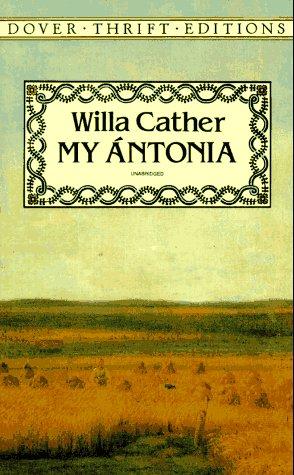
My Antonia by Willa S. Cather

My friend Paula, a Nebraska native, has been after me to read this book for years and now I understand. I’d been spending nearly all of my reading time with early 20th century mysteries and, quite frankly, they’d become tedious. After forcing myself through The Red House by A.A. Milne, I really felt like I needed a change of pace. I had downloaded a whole bunch of free books to my Kindle for this reading project, and My Antonia just happened to be at the top of the list, so I casually opened it one night a week ago to see what it was all about.

I found a beautiful, heartbreaking, luminous story that captivated me from the first page. Cather tells the story of Antonia Shimerda, a headstrong, handsome Bohemian girl whose family is transplanted to Black Hawk, Nebraska in the 19th century.  Antonia’s story is told through the eyes of Jim Burden, an orphan who also arrives to live with his grandparents in Black Hawk on the same train as Antonia and her family. The two become fast friends whose lives twine around each other over the course of a lifetime.

The interesting thing about this story that is so different from what I’ve been reading is that there really isn’t a storyline. This is a memoir, a re-telling of a bucolic if hard childhood on the prairie, coming of age in a small mid-western town, and adulthood not yet devoid of childhood innocence and affection between lifelong friends.

I was reminded of two stories as I read this one – Little House on the Prairie by Laura Ingalls Wilder and the 2010 Newbery winner Moon Over Manifest by Clare Vanderpool. The sod houses of Wilder’s early books are here, as is the red prairie grass, snakes, farms, and family devotion. The similarity to Manifest, Kansas is more in the characters drawn by Cather and Vanderpool than in the story. However, all three books share the same comforting, lovely tributes to the importance of family and friends.

Cather’s characters, from Antonia and her regal but defeated father, to the foreign farm girls who go to town as “hired girls,” to Antonia’s husband and colorful tribe of children, to the narrator – Jim Burden himself – are finely drawn and developed with care and compassion. She captures the tender friendship between Antonia and Jim, which becomes the thread that twines through the entire story and ultimately makes it successful.

A beautiful book that will stay with me for a long, long time.

5 out of 5 catalog cards