100 Books. 100 Years

100 Years. 100 Books. #5 – 1922


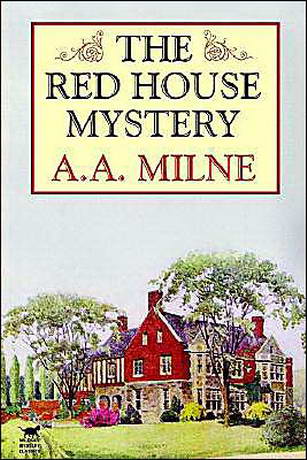
The Red House Mystery by A.A. Milne.

Most people know A.A. Milne as the creator of the beloved children’s story Winnie the Pooh, but Milne published mystery stories before he created Christopher Robin, the Hundred Acre Wood and the ubiquitous Pooh himself. The Red House Mystery, published in 1922, is typical of the Golden Age of British mysteries and is heavy on old school chums, amateur detectives, a “locked room” mystery, and a mysterious disowned relative who returns from a long banishment to Australia. The story begins with the murder of Robert Ablett, prodigal brother of Mark Ablett, country house squire and frequent house party host. The murder occurs during a house party and draws in household staff, a paradoxical cousin, and the aforementioned amateur detective who just happens upon the scene. There are secret passages, missing guns, a vanished suspect, and gossiping housemaids – all the necessary elements of a 1920s mystery.

The major flaw here is that there are too many characters who all sound alike, making it hard to follow the plot. I found the story to be overly wordy and way too long, with most of the action concentrated on the Ablett estate. I found myself skimming over multiple pages at a time looking for some action and finding little. I normally enjoy Golden Age mysteries, but this one left me cold.

1 out of 5 catalog cards

100 Books. 100 Years, Mystery

100 Years. 100 Books #4 – 1915..again


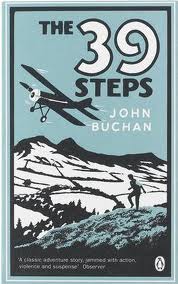
Being a mystery reader, I have to admit that I’ve looked at this reading project as an excuse to read early mysteries, which is what led me to select The Thirty Nine Steps by John Buchan. I was familiar with the film adaptation by Alfred Hitchcock so I figured the original story would be a good read and I was right.

The book introduces Richard Hannay, Buchan’s adventurous leading man who went on to appear in a number of other stories. Here, it’s early 20th century and Hannay, just settling into a somewhat boring existence in London after years in South Africa, finds himself smack in the middle of a deep, dark plot to assassinate a head of state. Hannay gets himself into a whole lot of trouble when he allows his neighbor to stay with him after hearing a wild tale about assassination plots and death threats, or at least Hannay thinks it’s a “wild” tale until he comes home to find the neighbor pinned to the floor of his bedroom by a wicked looking knife. The murder makes Hannay determined to fulfill the mission of the dead man – abort the assassination attempt and keep the world from tumbling into chaos and war. Calling on all his wits and cleverness, Hannay makes it out of London and into the wilds of Scotland, where he is hunted by the evil men responsible for the plot, which turns out to be much different than Hannay thought, but still deadly.

Saying this is a thoroughly enjoyable read is an understatement. Anyone partial to Robert Ludlum, John le Carre, James Rollins, and even Elizabeth Peters will recognize the seed of these authors’ characters in Buchan’s writing. In fact, Hannay’s tramping through the Scottish Highlands reminded me vividly of Elizabeth Peter’s Legend in Green Velvet, another deliciously entertaining story. Unlike other early 20th century stories I’ve read recently, The Thirty Nine Steps moves fast and doesn’t suffer from the lengthy descriptive sentences found in many works published during this time period. Give this fun, quick read a try and follow it with a screening of Hitchcock’s film adaptation.

4 out of 5 catalog cards

100 Books. 100 Years

100 Years. 100 Books #3 – 1915


Doctor Syn: A Smuggler Tale of the Romney Marsh by Russell Thorndike

I confess I selected this story because I remembered watching the Wonderful World of Disney production Scarecrow of Romney Marsh where Dr. Syn was played by Patrick McGoohan, aka The Prisoner, which I loved as a child, and which is available on DVD at the Chili Public Library!

Because I remembered the Disney production and because I watched it recently, the plot was fresh in mind when I began reading. However, I quickly discovered that Disneyfication isn’t limited to fairy tales as I came to know a very different Dr. Syn and residents of Romney Marsh as written by Mr. Thorndike.

The story is based on local tales of smuggling along the coast of Great Britain in the 18th century, where Romney Marsh was notorious as a destination for smugglers bringing in brandy and tobacco from France. Thorndike expands on the basic tale by introducing Dr. Syn and a host of colorful characters, such as Jack, a young lad with a highly developed sense of right and wrong who aspires to become a hangman, and even goes so far as to hire a man to build him a gallows on the tiny piece of land he owns in the Marsh.

This leg of the story takes place at the end of Dr. Syn’s adventures. During his lifetime, Syn went from living peacefully in Dymchurch-under-the-wall to becoming a wronged lover, to a ruthless pirate, right back to where he started on Romney Marsh. Having returned from a life of crime as the infamous pirate Captain Clegg, Syn settles down at home. He quickly discovers that the people of Dymchurch are heavily involved in smuggling, and also ascertains that they are in danger. He organizes them into a fearsome band of Devil Riders, led by the even more fearsome figure, The Scarecrow. The Scarecrow and the riders use a phosphorescent mixture to make themselves glow, thus lending them an air of devilry when they ride out to greet the smugglers ships at night.

Life goes on quietly until the arrival of Captain Collyer and his band of King’s men, come to stop the smuggling. Collyer and Syn match wits throughout, with Collyer eventually learning of Syn’s notorious past and attempting to bring him to justice.

There are no cute Disney fairies or quaint Englishmen here. These are rough and tumble characters who are handy with knives and guns, and ruthless enough to use them. There’s also one very odd scene with Dr. Syn capering about his study that certainly wasn’t part of the Disney version. The writing at times can become tedious, and is full of colloquialism and dialect, which can be a challenge to read. However, the action and storyline are enough to keep the reader involved.

Thorndike wrote a series of Dr. Syn stories, which are available as a collection via Google Books. He wrote the first Dr. Syn story in 1915 but didn’t publish another until 1935. Thorndike may be better known for his work in the theater, where, along with his sister, he was a Shakespearean actor with Ben Greet’s Academy. The Dr. Syn stories have been produced on film, television, on the stage and in comic books.

3 out of 5 catalog cards

Read more: http://100years100books.proboards.com/index.cgi?action=display&board=19111919&thread=6&page=1#ixzz1AZi6YyaR

100 Books. 100 Years

100 Years. 100 Books #2 – 1913


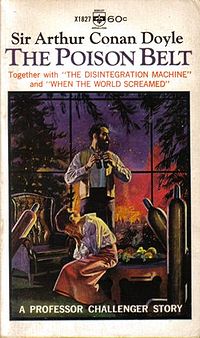
The Poison Belt by Arthur Conan Doyle

Not many people are aware that Sir Arthur Conan Doyle wrote more than the Sherlock Holmes stories. Doyle was a curious man and wrote many stories that today might be classified as science fiction. Take a peek at The Lost World (a 1912 classic) that imagined dinosaurs alive on earth long before Jurassic Park.

The Poison Belt suggests a murder mystery, but is in fact a nice little piece of speculative fiction in which Doyle imagines the course of events that would occur should the Earth “swim through the poisonous current which swirls like the Gulf Stream through the ocean of ether.” The story begins with journalist Mr. Malone being dispatched to interview his friend Professor Challenger. Those readers familiar with Doyle’s The Lost World will recognize the characters here – Malone and Challenger return, as well as Professor Summerlee and Lord John Roxton.

Professor Challenger has postulated through a letter in the London Times that the Earth has moved into a “poisonous belt” of atmosphere that is responsible for significant changes in the color spectrum as well as for widespread illness and panic in other parts of the world. Malone is dispatched to Challenger’s country home to get the story, but at the same time receives a summons from Challenger imploring him to “bring oxygen!” Malone meets Summerlee and Roxton on the way, they too having been summoned to Challenger in the same mysterious way.

Once they arrive at their destination, the three friends discover an excited Challenger who informs them they have but few hours to live before they also succumb to the poison belt. Challenger, genius that he is, has devised a way for the friends to last a little longer by sealing a room in his house. The room is furnished it with food and oxygen, which he believes will allow the friends to breathe and live beyond the rest of the household and neighborhood. As the day lengthens into night, the friends observe many terrible sights, such as a train running amok and eventually crashing into one giant heap, neighbors apparently dropping dead where they stand, and fires apparently burning great cities such as Brighton.

Our Mr. Malone, reporter to the end, records his observations and feelings as the night moves into day. As the sun rises, the friends see they are nearing the end of their oxygen supply and decide to meet death head-on. In a grand gesture, the window is thrown open and all prepare to meet their deaths. Or do they?

I was unprepared for the depth of Doyle’s speculation and found it quite refreshing. I am an avid Sherlock Holmes fan and hadn’t read anything else by the author, so this was a treat. Doyle’s rendition of what the world would be like after a catastrophic event is haunting, especially in a scene where a bell rings out over a London completely devoid of life. If Doyle had thrown in a few zombies or vampires, I might have thought I was reading Richard Matheson!

This is my entry for 1913 in my 100 Years. 100 Books reading project for 2011. I have to admit, I’ve started and stopped several books that I just could not read. This story, however, kept me interested and turning pages.

A solid 4 out of 5 date due cards.

Read more: http://100years100books.proboards.com/index.cgi?board=19111919&action=display&thread=4#ixzz1A7A1nTxG

100 Books. 100 Years, Children's

100 Years. 100 Books #1 – 1911


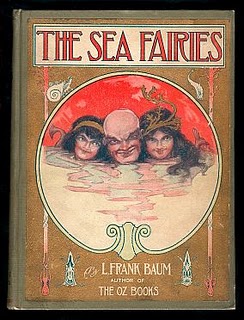
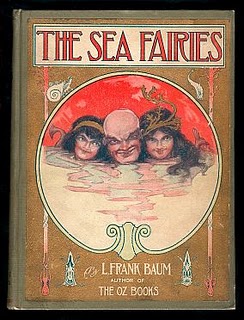
The Sea Fairies by L. Frank Baum

Book one in my Rochester Public Library 100 Year Reading Project proved to be an entertaining if somewhat silly selection. This is the type of fairy story Baum was noted for – a spunky little heroine, a wise old man, mischievous fairy creatures, and a scary monster. Sound familiar? Baum did, after all, write the Oz books.

The story begins with the Captain, a retired seafaring man with a wooden leg, telling little Mayre all about the mermaids who live in the deep sea and how “no one whut sees ’em ever gets out alive.” Mayre and the Captain set out one fine day for a simple row boat ride to explore the coast and caves of their seaside home, and when the Cap’n rows them into a favorite spot, the Giant’s Cave, they meet a Mermaid Princess, who uses her fairy magic to give both the child and old man fish tails and the ability to breathe underwater. They are taken to visit the Mermaid Queen, who introduces them to all sorts of sea creatures, including King Anko, one of the four ruling sea serpents in the oceans and the oldest one alive. During one of their forays into the ocean depths, the Mermaid Queen, Princess, Cap’n and Mayre (for some reason called Trot), are captured by a wicked magician who was defeated once by King Anko and took refuge in an invisible traveling castle. The wicked magician toys with them, until the Mermaid Queen finally decides it’s time to break out, which they do, with a little help from King Anko, who finally destroys the wicked magician for good.

This is a sweet little fairy story typical of the time and features vividly drawn characters indicative of Baum’s work. All the usual questions about mermaids are answered, for example…

How do mermaids breathe underwater without gills?  There is a very thin layer of air surrounding the mermaids’ bodies which keeps them warm and essentially dry and allows them to breathe naturally. Ever see bubbles coming up from the ocean floor? That’s mermaids breathing, of course!

A number of the scenes reminded me very much of Sponge Bob Squarepants, in fact. Decades before our friendly yellow sponge debuted on TV, Baum imagined full service restaurants at the bottom of the sea and creatures living in domed castles and homes. I bet when they were kids, someone read The Sea Fairies to the creators of Sponge Bob and some of the fantastic descriptions stuck. I’d bet Baum would be a fan!

For students of children’s literature, this would be a lighthearted, quick read. Fans of the Baum’s Oz books will appreciate the imaginative plot and plucky characters.

100 Books. 100 Years

100 Years. 100 Books. Warm Up.


The Wild Olive by Basil King, published 1910 by Harper & Brothers.

I thought I’d start with a book published in 1910 to get myself warmed up for my 100 Years. 100 Books reading project, which begins in January 2011 as part of the 100th anniversary celebration of the Rochester Public Library.

The Wild Olive was a best seller in 1910 and I can understand why. It has all the classic elements of good fiction – likable protagonists, exotic locales, a “good man gone wrong” plot, and, of course, a love story.

We begin with a condemned man’s desperate flight through the wilds of the Adirondacks, from a logging town where he was found guilty of murdering his uncle, to a secluded mansion inhabited by the judge who passed sentence on him, to a tiny hidden room in the side of the mountain where he is kept hidden by a mysterious girl, to the bustling, newly opened ports of Argentina.

Nory Ford, a pampered city boy from New York, finds himself shipped off to live with an uncle in a remote logging town in northern New York, where he finds little welcome from his cruel relative. Nory is accused and found guilty of murdering the old man, but is helped to escape by the residents of the town who apparently all hated the uncle. As fate would have it, Nory finds himself on the doorstep of a grand mansion perched high above a pristine lake, a mansion that just happens to be owned by the very judge who sentenced him to hang by the neck until dead.

There’s a nice little interlude where Nory and the judge converse about the nature of good and evil and right and wrong, highlighted by this wonderful passage:

The law assumes all men to be equal…Just as it assumes all men to be intelligent–only they’re not. The law is a very fine theory. The chief thing to be said against it is that five times out of ten it leaves human nature out of account. I’m condemned to death, not because I killed a man, but because you lawyers won’t admit that your theory doesn’t work.”

The two continue to argue the law, with Nory claiming to have been found guilty only because the law in the town couldn’t find anyone else to pin the crime on. Finally, Nory’s attention is captured by the appearance of a woman in white, beckoning him from the drawing room to the woods outside. He eventually finds the girl waiting for him in front of a lovely little, hidden cabin that she has made into an art studio. There she conceals him for several weeks until the search for him is called off. She refuses to tell him her name, so he eventually comes to think of her as the “wild olive” – the olive that is grafted into the olive of the orchard and introduces a new strain of flavor.

The girl eventually contrives to get him away from New York and from his death sentence. She just so happens to be independently wealthy and arranges passage for him to Ireland under the name Herbert Strange.

Eventually, Strange ends up in Argentina working for a firm that the Wild Olive had mentioned in passing. He works his way up from dock worker to manager, and on the way catches the eye of the company owner. Throughout the story, Nory/Strange struggles with the feeling that he has been discarded by organized society and forced to live just outside its reach.

Just as Strange begins a courtship that may bring him inside that organized society again, the Wild Olive makes a reappearance in his life and it all falls apart. However, the two declare their love for one another and vow to stay together and fight for Nory’s/Strange’s freedom back in New York.

Convoluted? You bet. Full of coincidence? Absolutely. Indicative of the times. Yes indeed.

Good Man Gone Wrong Saved By the Love of a Beautiful Woman.

The writing is also indicative of the time. Very flowery and descriptive, with lots of philosophy thrown in for good measure.

Not something I would normally pick up and stay with, but I plowed through and could imagine the appeal to young lady readers swooning over the handsome Mr. Strange.

A suitable warm up to 1911. I think this project is going to give me a solid grounding in the changing literary styles in 20th century American writing.

100 Books. 100 Years, Uncategorized

100 Years. 100 Books. 1910


I wrote on here a few weeks ago about my reading project for 2011 that will commemorate the 100th anniversary of the founding of the Rochester Public Library. In short, I plan to read 100 books, one from each year RPL has existed. Although it’s not even halfway to 2011 yet, I thought I’d get myself in the mood by reading something from 1910. So, here’s a list of best sellers from that year. I will write about the books I read from each list, but encourage all of you to do the same.

  1. The Rosary by Florence L. Barclay
  2. A Modern Chronicle by Winston Churchill (owned by RPL)
  3. The Wild Olive by Anonymous (Basil King)
  4. Max by Katherine Cecil Thurston
  5. The Kingdom of Slender Swords by Hallie Erminie Rives
  6. Simon the Jester by William J. Locke
  7. Lord Loveland Discovers America by C.N. Williamson and A.M. Williamson
  8. The Window at the White Cat by Mary Roberts Rinehart (Gates owns PB; RPL & Winton own BOT)
  9. Molly Make Believe by Eleanor Abbott
  10. When a Man Marries by May Roberts Rinehart

Not many of these are owned in MCLS, so ILL might be in order. However, nine of the titles listed above are available in full form through Google Books, and I have linked them to the Google record.

Happy Reading!

100 Books. 100 Years

Reading Project for 2011


So here I am re-launching this blog after about 18 months of non-stop work with lots of changes in my life. And how do I do it?

I announce a project that will keep me — and I hope, some of YOU! — busy in 2011.

The Rochester Public Library will be 100 years old in 2011, and in honor of that auspicious occasion, I intend to read 100 books — one from every year RPL has existed.

100 Books. 100 Years.

I’ve started building lists of books published from 1911-2011. Here are some that look promising:

  • 1911 – Queed by Henry Sydnor Harrison – Haven’t found a good description of the book, but this quote from the frontispiece on Google Books is intriguing: “Mr Queed, you are afflicted with a fatal malady. Your cosmos is all ego.”
  • 1912 – Tante by Anne Douglas Sedgwick – about the destructive relationship between a concert pianist and her young protégée.
  • 1921 – The Sheik by Edith M. Hull – bestselling romance novel which became the basis for Rudolph Valentino’s film of the same name.
  • 1926 – The Private Life of Helen of Troy by John Erskine – just what the title says. Later made into a film.

There are lots of good stories just waiting to be re-discovered. I plan to write about my year-long journey here, and am thinking about possibly starting a book discussion club if enough people want to join me.