Young Adult

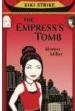
Kiki Strike and the Empress’s Tomb


kiki1.jpgAdrienne sent me ARC for this new Kiki Strike a few weeks ago. I started it, put it down for some reason and forgot about it. I found it again and have spent the last few days immersed in the Shadow City, hungry ghosts, Chinese gangsters, giant squirrels and the enigma that is Kiki Strike.

Kiki Strike, leader of The Irregulars, a motley group of very talented 14 year olds, once again finds herself up against vicious Russian gangsters being directed by her arch nemeses, Livia and Sidonia Galatzina, as well Chinese gangster Lester Liu. This chapter in the Kiki Strike saga revolves around secrets and the damage caused by keeping them too long.

As in the first Kiki story, the writing is hip and the characterizations crisp, with a plot that stretches the boundaries of belief but makes you believe nonetheless. I keep hoping for a Kiki Strike movie, but would be satisfied with something on Adult Swim. Edgy girls will love this and so will their post-punk moms.
General, Young Adult

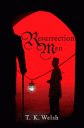
Resurrection Men


Resurrection MenT.K. Welsh’s last book, The Unresolved, was one of my favorites of 2006, and Resurrection Men doesn’t disappoint. In the 1830’s, an Italian boy witnesses his parents being murdered, and is then sold as a cabin boy on a ship. A bad fall from the rigging means he’s no longer useful so he’s thrown overboard. Miraculously, he makes it to shore and is found by an old man who nurses him back to health, only to sell him to a couple of “resurrection men” whose job is to procure corpses for doctors to autopsy. He makes his way to London, where he plunges into the worst of the underbelly of society — beggars, prostitutes, thieves and murderers. After many trials and tribulations, the boy’s decency and courage help him rise above the life he’s been forced to live.
Of course, the inevitable comparison to Dickens’ Oliver Twist comes to mind, but Resurrection Men is far more than that. Welsh makes the horrific living conditions, especially those for children, come alive here. Welsh doesn’t rely on innuendo, but lays it all out, from the dens of beggar children to the trade in child prostitution, so the reader comes to know that living in London in the 1830’s was anything but idyllic. Reading this, I was reminded of a book I read years ago called The Anti-Society by Kellow Chesney which described the lives of the poor during the reign of Queen Victoria. Most history books recount the glorious reign of the Queen and ignore the harsh reality lived by her poorest subjects. Welsh succeeds to bringing that reality to vivid life. If you want to read more on this topic, adults can try The Great Stink by Clare Clark or Victorian London by Liza Picard, while younger readers will enjoy The Whispering Road by Livi Michael.