General

The Thirteenth Tale


It seems as though I’ve read more books about people who love books in the last year than ever before. It all started with The Yellow-Lighted Book Shop, segued into John Dunning’s The Bookman series, stopped off in fantasy land with Cornelia Funke’s Inkheart, and most recently took a turn on the bestseller list with The Thirteenth Tale by Diane Setterfield.

The Thirteenth Tale is the famously omitted story from author Vida Winter’s collection of short stories. Margaret Lea, book lover and amateur biographer, is invited to hear the true life story of England’s most popular author. When Margaret arrives at Winter’s home, she finds a dying woman with one foot firmly in the past. As Vida’s story unfolds, Margaret finds herself drawn into the darkly strange world of the the Angelfield twins. She is unsure of how much is true and how much is flotsam from Vida’s compost pile of story fragments. As Vida tells her story, so does Margaret, who harbors her own untold story.

Setterfields characters are magnificent. The otherwordly existence of the Angelfield family is at once repulsive and fascinating. There are many strands to this story that wave all over the place throughout, but which are all caught up in a neat knot at the end. I was engrossed in this story from the start and — gasp of surprise — didn’t even peek at the end. Good thing too, because I sure didn’t see the truth in Vida’s story until the very end. All in all, this was one of the most satisfying books I’ve read in awhile.

General

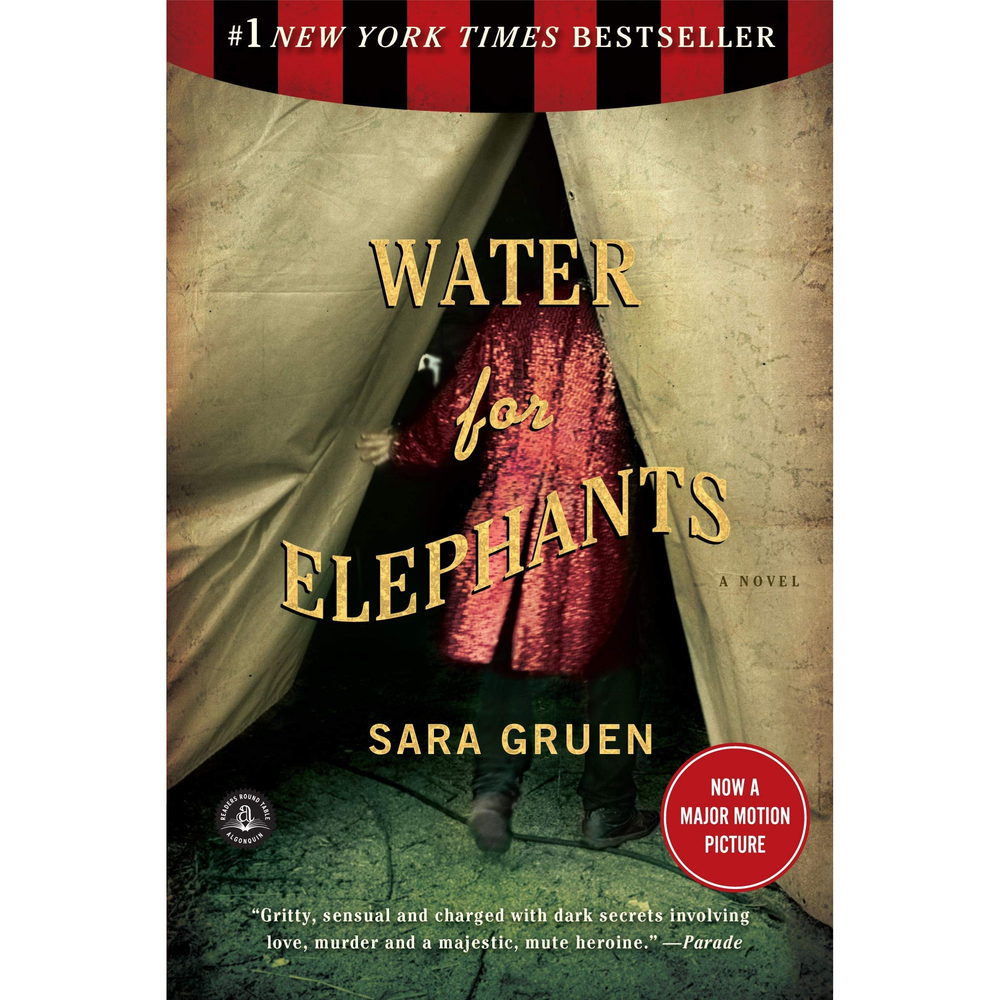
Water for Elephants


I don’t normally appreciate stories that flip back and forth between two or more time periods or sub plots. I find them distracting and annoying because the transitions are usually abrupt and jarring. Until now, the only book I’ve read that does the transition between present and past skillfully is Fried Green Tomatoes at the Whistle Stop Cafe by Fannie Flagg; Water for Elephants by Sara Gruen is the second.

Gruen tells the story of Jacob Jankowski, a ninety — or is ninety-three? — year old former circus vet whose life takes an exciting turn when a circus sets up shop across the street from his nursing home. The present-day circus sparks memories of Jacob’s own experiences with the Benzini Brothers Most Spectacular Show on Earth, which plunged him right in the middle of love, hate, despair, and wild animals.

Most of the story is told in flashbacks to the summer of 1931, and begins when Jacob’s parents are killed a few days before he’s scheduled to sit his final exams at Cornell College of Veterinary Medicine. Senseless with grief, he hops a train that just happens to be a cab of the Benzini Brothers. When Uncle Al the circus boss discovers Jacob is a Cornell educated vet, he pulls Jacob into the Benzini family and sets him to work caring for the animals in the circus menagerie. Along the way, Jacob falls in love — with Marlena the horse trainer as well as with the animals he cares for — especially Rosie, a bull elephant who only understands Polish.

Back in the present, the older Jacob struggles with the limitations age has inflicted on him, all the while waiting for his family to come take him to the circus. When it becomes clear that his family has forgotten him, Jacob picks up his walker and gets himself across the street to the show. There he meets the boss, who is fascinated to discover Jacob was in the thick of one of biggest circus disasters of all time. During the course of their conversation, Jacob, ever the con-man, convinces the circus boss to take him along for the rest of the season, effectively running away with the circus for a second time.

Gruen has done her homework and includes wonderful details of circus life in the 1930s, including real life stories like the elephant that was responsible for drinking all the lemonade made for the concession stands, and the paralysis — jake leg– suffered by the hard-drinking circus men and associated with drinking Jamaica Ginger Extract while real liquor was outlawed under Prohibition. The story moves quickly and contains enough action to keep the reader satisfied. Highly recommended.

General, Mystery

Resurrection by Tucker Malarkey


Cover ImageGrowing up in an Irish Catholic family in the 1960s and 70s was an experience steeped in church-every-Sunday, frilly white communion dresses, tiny silver crucifixes on delicate little chains, nuns enveloped in billowing habits, and don’t-you-dare-lean-your-behind-on-the-pew-when-you’re-kneeling instructions from Mom & Dad. I can tell you with much certainty that the Catholic Catechism I used in Sr. Paul Regina’s religion class sure didn’t have anything in it about the Gnostic Gospels.

As I’ve aged, I, like many of my contemporaries, have lost a little faith in the teachings of the Catholic Church. It’s not so much a loss of faith but a real questioning of the things I was taught so many years ago. So I naturally gravitate to books that deal with themes that question the same things I question. In this case, that questioning involves the authority of the four gospels of the New Testament, and the place in history and faith of the Gnostic Gospels, or New Testament apocrypha.

Resurrection is a fictionalized account of the discovery of the Nag Hammadi gospels in post World War II Egypt. Gemma Bastian, our intrepid heroine, is a war-damaged nurse who lived through the Blitz in London which killed her mother and destroyed her home. Shortly after the war ends, her father, a Biblical archaeologist, is found in his Cairo office, dead of an apparent heart attack. Shortly after being informed of his death, Gemma receives a mysterious letter from him that sends her to Cairo on a mission. As she discovers more about her father’s work, it becomes clear that he had discovered something that would rewrite the history of Christianity. The story follows Gemma as she slowly pieces together the last days of her father’s life and culminates in her possession of the Nag Hammadi gospels.

This reminded me very much of early Elizabeth Peters fiction, which owes a lot to the gothic romances so popular in the 1960s and 70s, and which evolved into the inimitable Amelia Peabody series. The three primary characters — Gemma, Michael and Anthony (the two brothers who vie for her attention) are colorful and well drawn, but the real action in the story involves the discovery of the gospels, what they contain, and what happens to them. Malarkey’s story whet my appetite enough that I’m currently reading the scholarly works on the Gnostic Gospels by Elaine Pagels. I realize that my father, who spent the first part of his young adulthood in the seminary, is probably spinning in his grave, but I have to say that what I’m reading is making me re-connect with the basis of my Christian belief. And that’s not a bad thing.

Children's

The Boy Who Was Raised By Librarians


I received one of those friendly little alerts from Amazon.com this morning about this book so I headed over to Amazon to check it out, pre-pub. At first, I thought it was illustrated by the same guy who did one of my all-time favorite children’s books, Double Trouble in Walla Walla written by Andrew Clements & illustrated by Sal Murdocca. Alas, it’s not, but the cover art still rocks. Here’s the Amazon blurb…

This humorous tale of a curious young boy and his single-minded quest for knowledge is a heartfelt and affectionate tribute to librarians everywhere.

Every day after school Melvin goes to the library. Everything has its place in the library and Melvin likes it that way. And his favorite people–Marge, Betty, and Leola-are always in their places, behind the reference desk.

When something interests Melvin, his librarian friends help him find lots and lots of books on the subject. When he collects creepy bugs in a jar, they help him identify, classify, and catalog the insects. When he is cast as the Enormous Eggplant in the school play, Betty reads aloud from Organic Gardening to help him find his motivation.

As the years pass, Melvin can always find the answers to his questions-and a lot of fun-in the library. Then one day he goes off to college to learn new things and read new book. Will he leave the library and his friends behind forever?

Readers will enjoy Brad Sneed’s delightful illustrations that colorfully capture the fun-loving spirit of Carla Morris’s story about the contagious enthusiasm of learning.

Lucky librarians know a kid like this; luckier ones know several kids like this. There really isn’t anything more satisfying than seeing a kid who has used the library regularly –I mean really used its resources — grow up to become something special. I’ve had the pleasure of knowing several kids like that and when I’m doubting my choice of profession, thinking about these kids always brings me back around.

There’s Karl Slominski, who was part of my very first young adult book discussion group back in 1996 and who, at age 13 created a full-sized wall mural in my old library and called it “The Stuff that Dreams Are Made Of.” Karl is now a successful graphic artist whose work can be see at Slomotion Art. Last I heard, he was working on storyboards for a new Edward Norton movie.

Then there’s Kaylen Lott, who was part of my young adult volunteer group back in the late 1990’s and who is now doing graduate work in immunology at Upstate Medical Center in Syracuse. I remember Kaylen telling everyone she was going to save the world, and now she’s on the way to doing just that.

What I love so much about books like The Boy Who Was Raised By Librarians is that they do such a fabulous job of explaining what we do and how much of an effect we have on children. Now the real challenge is getting some of those kids whose lives we change in the positions of power that control the money. That’s why I love George Maziarz so much. Every time I see him, he tells the story of how he grew up right next door to the Tonawanda Public Library and how he spent so much of his childhood inside that building. And today, he is one of the strongest supporters of libraries in Albany. We need more like him.

This post is also published on my library blog – Sources of Inspiration.
Mystery

The Web She Weaves


After having immersed myself in YA fiction for the CYBIL Awards, I decided to ease back into grown-up reading with this sweet little anthology of mystery and suspense stories written by women. Edited by Marcia Muller and Bill Pronzini, heavy-hitters in the crime fic world, these stories run the gamut from classic writers like Mary Roberts Rinehart, Dorothy Sayers, Agatha Christie, and Katherine Mansfield to more contemporary ladies such as Patricia Highsmith, Ruth Rendell, Joyce Carol Oates, and P.D. James.

Anthologies are usually mixed bags, with the stories running from excellent to really, really awful, but this collection doesn’t suffer from that type of poor selection. Each and every story is a gem, a masterpiece of psychological suspense, beginning with the masterful The Lodger by Marie Belloc Lowndes. It’s been many years since I first read this story, and it hasn’t lost its tension one little bit. Lowndes tells the story of the Buntings, an ordinary couple who find themselves with a weathy, mysterious lodger who comes to them during the height of the Ripper murders in London’s East End in the 1880s. Mrs. Bunting knows there’s something not quite right with this gentleman who conducts mysterious experiments in his room, and who regularly burns his clothing. Lowndes does a fine job of revealing only a few details at a time, but just enough to build tangible tension in the household. The climax of the story, as the lodger nearly comes face to face with the one man who would recognize him, is almost a relief for the reader.

Muller and Pronzini have selected the very best of the best stories from all the authors represented. Entries such as The Snail-Watcher by Patricia Highsmith and McGowney’s Miracle by Margaret Millar totally made my skin crawl, while stories such as Cattails by Marcia Muller and The Possibility of Evil by Shirley Jackson skillfully expose the human capacity for evil. If you’re looking for a book you can read leisurely, try this. It will surely keep you up at night!

Uncategorized

The CYBILS, or Why I Haven’t Posted Here in Forever


Hurrah! The CYBIL Awards were announced today! Most of you know I was a judge for the YA Fiction CYBIL, and spent most of my reading time in January with the five finalists, which were all incredible books. I’ve been waiting until the awards were announced to post my reviews of the five YA finalists, so here they are!

Nick & Norah’s Infinite Play List by Rachel Cohn and David Levithan – totally rocks. This story grabs you by throat and doesn’t let go. Norah’s character is spot on for the good kid confused by what’s happening around her. Boys, school, demanding friendships –all wrapped up in a blanket of music. I loved seeing the softer side of Nick, — the boy who can quote lines frmo Dirty Dancing right alongside the queercore bassist scene kid. This book captures the fear, confusion and frustration of teenage love beautifully. I particularly liked how the gender lines were blurred –Nick holding hands with Dev, Tris teaching Norah how to kiss –because that is such a true depiction of how boys and girls relate to each other in that scene. My favorite line in the book — “The moshpit doesn’t lie.” One quibble, though. I really liked how Tris was developed as the story went on and how she impacted Nick & Norah’s relationship, but I wish the author had done a little more with Tal, Norah’s ex. We know a lot about Nick’s relationship with Tris, but not so much about Norah & Tal. Of all the books, I think this speaks to contemporary teen life the best.

Rules of Survival by Nancy Werlin – This book totally blew me away. I read it in a single sitting. This story of three young children caught up in a whirlwind of neglct and abuse from a wacked out mother is told in in the form of a long letter from the oldest boy to the youngest girl in the family. I was riveted from the first page and even found myself skipping ahead to see what Nikki (the mother) would do next. The growing relationship between Murdoch (a guy two of the kids first encounter as he defends a child against an abusive parent) and the children was handled evenly throughout, and I thought the revelation of Murdoch having been abused as a child was placed well at the end. I think we all knew there was something in his past, but I didn’t suspect the extent of his abuse or the outcome. Aunt Bobbi, Nikki’s sister, and the father were the weakest characters in the story. Their about-face regarding the care of the children was a little too contrived, although the scene between Nikki and Bobbi over Thanksgiving dinner was written beautifully and showed how Bobbi and the kids were still trying to please Nikki and keep her from blowing up. I especially liked the fact that the story didn’t end with Nikki’s death, but with the children moving on with their lives while she drifted. There was such hope at the end of this story, which isn’t something you always find in YA stories.

Hattie Big Sky by Kirby Larson – loved this book completely. It’s 1917 and Hattie, a put-upon orphan with lots of spunk, inherits a land claim in Montana from an uncle she’s never met. She, of course, packs up everything she owns and heads west, where she must “prove” the claim by erecting a daunting amount of fence and bringing in a crop. The story, the characters, the setting — everything clicked. One of the things I loved about this story was Hattie’s perseverance. She kept plugging along in the face of some really difficult challenges, and the scene where she tells Traft that she’s ready to sell just about made me cry. I so wanted to give him a good kick in the butt. The relationship between Hattie and Perilee’s family is also handled really well. The anti-German sentiment exhibited by the townspeople was contrasted beautifully with the images of Karl and Mr. Ebgard as good, honest men. I have to say that I really didn’t see Mattie’s death coming and yeah, that part *did* make me cry! However, this is one of those books that straddle the line between juvenile and young adult. The appeal of this book is somewhat limited — girls who grew up on Little House and Dear America will love it — as will adults who have fond memories of Anne of Green Gables.

A Brief Chapter in My Impossible Life by Dana Reinhardt – It took me a couple tries to get into this one, but once I did, I was hooked. Sixteen year old Simone is confronted with the possibility of meeting her birth mother, an introduction she does not want nor relish. Once they meet, however, their relationship becomes precious, but is ended abruptly by Rivka’s death. At first, I found Simone petulant and annoying, but she grew on me after awhile. I particularly liked her confrontations with the Evil Bitch outside the coffee shop and at the ACLU rally. What unsettled me about this story was the number of budding relationships the author was juggling –Simone and Rivka, Simone and the boyfriend, Cleo and Darius — too many to develop properly. I also thought the Orthodox family was one-dimensional, although I loved how Rivka introduced Simone to the parts of her faith and ritual that were important to her. Simone’s struggle with atheism versus faith was handled well, although I think it could have been developed more.

The Book Thief by Markus Zusak– okay. I just don’t get it. I found this book to be weird, depressing, and a chore to read. The writing was spectacular, although I did finally have to listen to this in audio format after I couldn’t stay focused on the book. Zusak has a fabulous way with words and has created imagery far beyond anything I’ve read before, but I was just weighed down by this book. Others loved it, but not my cup o’ tea.
Uncategorized

Where I’ve Been


It’s true that I haven’t posted much here lately. Not because I haven’t been reading…I have. But because lots of things have been going on in my life. I started a new job yesterday as Assistant to the Director of the Rochester Public Library & Monroe County Library System, which meant I spent the last month cleaning out 11 years of stuff at my old job, setting up the new Director there, and saying goodbye to people who have become my family. At the same time, I’ve been neck deep in the judging of the CYBIL Award for YA Fiction. The five finalists — The Book Thief, Nick & Norah’s Infinite Play List, Rules of Survival, Hattie Big Sky, and A Brief Chapter in My Impossible Life — in the YA category are all fabulous books and you should read every one of them. I can’t tell you where we’re at in deliberations, but we’re close.

I’ll leave you with one of my favorite quotes from Norah in Nick & Norah’s Infinite Play List

The mosh pit never lies.


Uncategorized

Fantasy Meme


Here’s another one of those “50 Books” memes that have been floating around. This one’s all Fantasy, baby. The rules are simple. Bold the titles you’ve read, put an * in front of the ones you liked and a – in front of the ones you didn’t. This meme has reminded me of a whole bunch of great fantasy books to give to Scott. He’s a little lost right now — he devoured the latest R.A. Salvatore book in one sitting.

  1. * The Chronicles of Prydain – Alexander, Lloyd
  2. Carrie’s War – Bawden, Nina
  3. Death of a Ghost – Butler, Charles
  4. – Ender’s Game – Card, Orson Scott
  5. * Summerland – Chabon, Michael
  6. * King of Shadows – Cooper, Susan
  7. * The Dark is Rising sequence – Cooper, Susan
  8. * Stonestruck – Cresswell, Helen
  9. * Charlie and the Chocolate Factory – Dahl, Roald
  10. * Matilda – Dahl, Roald
  11. Ingo – Dunmore, Helen
  12. * The Sea of Trolls – Farmer, Nancy
  13. Madame Doubtfire – Fine, Anne
  14. Corbenic – Fisher, Catherine
  15. * Inkheart – Funke, Cornelia
  16. * The Thief Lord – Funke, Cornelia
  17. The Owl Service – Garner, Alan
  18. Happy Kid! – Gauthier, Gail
  19. Stormbreaker – Horowitz, Anthony
  20. * Whale Rider – Ihimaera, Witi
  21. – Finn Family Moomintroll – Jansson, Tove
  22. * Fire and Hemlock – Jones, Diana Wynne
  23. * The Phantom Tollbooth – Juster, Norton
  24. * The Sheep Pig – King Smith, Dick
  25. Stig of the Dump – King, Clive
  26. * A Wizard of Earthsea – Le Guin, Ursula
  27. – The Voyage of the Dawn Treader – Lewis, C S
  28. * The House at Norham Gardens – Lively, Penelope
  29. Goodnight Mister Tom – Magorian, Michelle
  30. – The Changeover – Mahy, Margaret
  31. * The Stones are Hatching – McCaughrean, Geraldine
  32. * The White Darkness – McCaughrean, Geraldine
  33. * Beauty – McKinley, Robin
  34. * Sabriel – Nix, Garth
  35. * The Borrowers – Norton, Mary
  36. * Mrs Frisby and the Rats of NIMH – O’Brien, Robert
  37. * Z for Zachariah – O’Brien, Robert
  38. A Dog So Small – Pearce, Philippa
  39. Life As We Knew It – Pfeffer, Susan Beth
  40. * A Hat Full of Sky – Pratchett, Terry
  41. * His Dark Materials sequence – Pullman, Philip
  42. * How I Live Now – Rosoff, Meg
  43. * Harry Potter and the Prisoner of Azkaban – Rowling, J K
  44. * Holes – Sachar, Louis
  45. The Foreshadowing – Sedgwick, Marcus
  46. Marianne Dreams – Storr, Catherine
  47. When the Siren Wailed – Streatfield, Noel
  48. * The Bartimaeus Trilogy – Stroud, Jonathan
  49. * The Hobbit – Tolkien, J R R
  50. * Charlotte’s Web – White, E B
Uncategorized

CYBIL’s YA Finalists


A few months ago, I wrote that I was going to be one of the judges for YA fiction in the first annual CYBIL awards. Well, I am delighted to report that the shortlist of five titles was released January 1 and that I am looking forward to a month of fabulous reading and debate. So, without further ado, the five finalist for the YA CYBIL award are:

Uncategorized

Long Time No See


Man, it’s been over a month since I posted last. Although I have been reading, my reviewing & posting took a backseat to Christmas baking during December. So here’s to playing catch-up….

I read Sea of Monsters by Rick Riordan in a day. I love this guy! And the stories he writes are amazing. I so want to be a demi-god, but I can’t decide between being a Daughter of Athena or a Daughter of Poseidon. Anyway, Riordan spins yet another wonderful story about Perseus Jackson and his adventures as a Son of Poseidon. This time, the very existence of Camp Half-Blood is being threatened by the bad guys. Someone has poisoned the tree that protects the camp, and now all sorts of nasties are attacking. Riordan again starts the story with Percy being attacked at school, this time by fierce cannibal giants who blow up the gym during a game of dodgeball that would give even Ben Stiller pause. Aided by his homeless hulk of a friend Tyson, who turns out to be much more than Percy imagined, and the ever-ready Annabeth, Percy escapes and heads back to Camp. He finds things much changed there, with beloved camp leader Chiron being replaced by Tantalus, who obviously doensn’t have the best interests of the campers at heart. Eventually, Percy, Annabeth and Tyson set off on a quest to find the Golden Fleece, the only thing that can cure the tree and save the camp. Great fun from one of the most talented writers around.

Less satisfying is Tony Hillerman’s latest, Shape Shifter. I said this about his last effort, too — Hillerman needs to find new material. He needs to let go of Joe Leaphorn and focus more on the characters of Jim and Bernie Chee. Leaphorn is tired and dull, and so is Shape Shifter. Very disappointing.

Right now, I’m reading the Rescue Artist: a True Story of Art Thieves and the Hunt for a Missing Masterpiece by Edward Dolnick, which is all about the theft of Edvard Munch’s The Scream and how it was recovered. So far, it is a fascinating look into the world of art theft, which sometimes includes books. Let me tell you, it has made me think twice about some of the rare books we have in the library and how they are accessed. After reading some of the things in this books, I think PBS or BBC should do a mystery series on the Art Squad of Scotland Yard. Very fascinating stuff….