Uncategorized

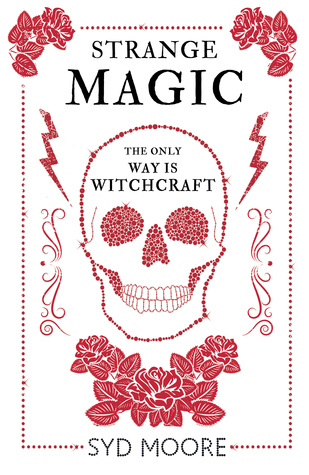
Strange Magic by Syd Moore


img_1212“Just because things are strange, Rosie, doesn’t mean they’re not true.” This sentence aptly sums up the premise of this new series from Sydney Moore. We first meet Rosie Strange as she travels to the Essex Witch Museum, which she has inherited from her estranged grandfather, Septimus Strange. As she wanders the moldy museum, she meets the semi-creepy caretaker Bronson and the handsome & quirky curator, Sam Stone. Soon she finds herself smack in the middle of an adventure in which she and Sam must acquire the bones of a witch dead for 400 years in order to save the life of a small boy possessed by the spirit of said witch’s son.

Underneath the expected editing issues you typically find in an advanced reading copy is an entertaining plot and a budding chemistry between the likable Rosie and Sam, making this a series to watch. The introduction two-thirds into the story of the MI5 Occult Division (and the suave agent Monty) was a little jarring, but holds promise for the series. This will be a welcome addition to other “witchy” series like Juliet Blackwell’s Lily Ivory books. Recommended.

Mystery, Uncategorized

The Z Murders


imageI read a number of early 20th century mystery/crime novels while working on my 2011 reading project – 100 years, 100 Books – including such classics such as The 39 Steps by John Buchan and The Red House Mystery by A.A. Milne, along with, of course, Agatha Christie and Dorothy L. Sayers.

J. Jefferson Farjeon was a lesser known but still accomplished member of the cadre of writers who produced these early mysteries. The Z Murders follows the typical plot of many mysteries from that era – a dashing, clever man meets a mysterious damsel in distress and attempts to outwit the police and the criminals while embarking on a madcap chase across England. In this instance, Richard Temperley spends most of the book chasing the mysterious Sylvia Wynne, who spends most of the book refusing to explain her predicament to Temperley. A disfigured villain with no arms, plenty of disguises, quaint and trustworthy villagers all combine with the likable Temperley and the reticent Wynne to make a pleasant if somewhat confusing mystery.

The lack of foreshadowing throughout most of book left me fairly unsatisfied and irritated. The reason for the “Z Murders” and the relationship between the two villains is only explained in the last couple of chapters, and not very well. If you really love British mysteries from this era, you’ll like this book well enough, but it’s not one that I’ll remember for very long.

Uncategorized

The Death Chamber


imageThere are very few books that give me real, wake-up-in-a-cold-sweat nightmares. This is one of them.

I’ve stopped giving a synopsis of books in these “reviews” because *everyone* does that; instead, I am just going to say that the first scene with the blind guy locked in the execution chamber totally did me in. I dreamed about his experience two nights in row. Then I got to the *second* time the blind guy (and our heroine) are locked in the same place, then pursued by a very creepy guy. Cue third sleepless night.

Rayne does a masterful job of telling three stories concurrently – in 1917, 1938-1960, and present day. It’s a rare author who can pull this off, but she does it really well, and brought all three stories together in one satisfying conclusion.

Death Chamber joins Peter Straub’s Ghost Story as scariest books ever.

Mystery

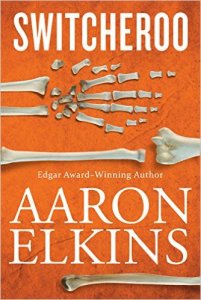
Switcheroo


imageGideon Oliver has been one of my favorite characters for years and I always eagerly anticipate a new story. Switcheroo began with a really interesting look into what happened to the Channel Islands during World War II, focusing on a wealthy family who engineered the first “switcheroo” in order to save their sickly child from certain death under German rule. We soon learn that the two boys who were switched were also part of an unsolved murder from the 1960s. When Gideon meets the grandson of one of the switched boys, he agrees to visit the Channel Islands and examine bones that were recovered from a tar pit, supposedly belonging to one of the boys. Of course, Gideon discovers all sorts of family secrets and subterfuge, leading to what, unfortunately, was a conclusion I spotted chapters before the end. And that’s my quibble. In a story where clever plotting abounds, the end was just…unremarkable. But, still, it’s Gideon Oliver and Aaron Elkins, which always means an entertaining couple of hours. Just not the best in the series….

Uncategorized

The Book of Speculation by Erika Swyler


image“Once you’ve held a book and really loved it, you forever remember the feel of it, its specific weight, the way it sits in your hand.” The Book of Speculation by Erika Swyler

There are only a few books I’ve encountered in my reading life that have left that kind of mark on me, and I am always surprised when a new one gets added to that category. The Book of Speculation is one of those unexpected gifts.

I didn’t go looking for it. I was browsing in B&N, killing time between some meetings a few days before my much anticipated July vacation, when I happened upon TBOS on the New Releases rack. I recognized the title as one I’d added to my GoodReads a couple weeks ago, and it looked promising. I liked the feel of it in my hand and I loved the way the text looked as I flipped through the pages, so I bought it and tossed it in my vacation book bag.

Days later, unpacked and at ease on the shore of a Northern NY lake, I opened TBOS and lost myself completely in this lovely story of a librarian, a bookseller, and a mysterious book that served to blend past and present, fairy tale and tragedy.

Simon Watson is a reference and archival librarian living in an ancient house perched precariously on the north shore of Long Island. Simon receives a mysterious book from an unknown bookseller just as he is let go from his position at the library. The bookseller has sent him the book because it has in it the name of one of Simon’s great-great grandmothers. The book piques his interest, as it recounts the movements of a traveling show which apparently included the women of his family, all of whom died by drowning on July 24, including his mother. Simon becomes obsessed with the idea that his sister, now also a performer in a traveling show, will suffer the same fate as July 24 comes closer. Using his library connections and his own research skills, he pieces together a lovely, tragic, and ultimately frightening story of love and loss that reconnects the family first established in that 18th century traveling show.

Swyler skillfully blends the past and present in a way that doesn’t jar the reader, but floats you gently along two parallel currents that eventually meet in a fury of a storm. There are plenty of unexpected events that surprise, delight, and sometimes frighten, keeping the readers attention throughout. Swyler’s use of water as a metaphor knitted into the fabric of the story successfully binds the past and present, and her details around circus and show life are wonderfully colorful.

I savored each sentence of TBOS, pacing my reading to draw it out over a few days because I loved it so. This is a book I will come back to again, without a doubt, and is one of those books I will remember long after this reading. In that way, The Book of Speculation joins Jane Eyre, The Historian, Peace Like a River, Harry Potter and the Sorcerer’s Stone, and a handful of others on my “Read and Read Again” shelf.

Highly recommended.

Uncategorized

The Mapmaker’s Children


“While Sarah’s family had lost nearly everything at Harper’s Ferry, the good would rise as unstoppably as a river after the storm.” This one sentence aptly describes the tone of this lovely little piece of historical fiction from Sarah McCoy. The stories of two women, Sarah Brown and Eden Anderson, are told through alternating chapters where we experience the frustration, heartbreak, and joy of their lives. McCoy connects Sarah and Eden in two specific ways – they both experience transformative love in the same house, although more than a century apart, and both experience the utter heartbreak of not being able to bear children.

Sarah Brown is the daughter of abolitionist John Brown who was executed after his history-making raid on Harper’s Ferry just prior to the Civil War. We first meet Sarah as she is recovering from a near-death experience with dysentery which leaves her barren. She is determined that her life, that *she* will not be defined by her inability to procreate, and so she begins using her artistic ability to draw maps for slaves on the Underground Railroad. Immediately after her father’s failed raid in Harper’s Ferry, Sarah, her mother, and her sister Annie travel to New Charlestown to stay with the Hill family while her father prepares for his execution. While there, Sarah begins to care for Freddy Hill, son of their host. Their budding romance grows through a lively correspondence and occasional meetings, until Sarah finds herself in the position of having to refuse Freddy’s marriage proposal. Sarah leaves the Hill home and returns to her studies in Saratoga, until she is called again to Freddy’s side as he hovers near death after being shot in the War. Ultimately, Sarah joins her family and moves West to California, where she lives out her days, without Freddy but caring for two free-born twins sent to her for safety.

One of those twins and her doll becomes the thread between the past and present in New Charlestown, between Sarah and Eden.

Eden Anderson is a successful businesswoman married to the love of her life who is nonetheless broken by her inability to conceive. We first meet Eden and her husband Jack as they struggle to acclimate to a new home in the small town of New Charlestown. Jack is away on business most of week, while Eden rarely leaves her bed, paralyzed by years of fertility treatments, hormone injections, and failed pregnancies. Eden slowly comes back to life as first a puppy then a neighbor child come into her life and reintroduce her to the joy of living. Eden, fascinated by a porcelain doll head she discovers in a root cellar in her kitchen, begins the process of getting her house on the National Register of Historic Places. She enlists the aid of locals whose families have lived in the area for generations and ultimately discovers a very real connection of the past to the present which helps her begin to heal.

When authors attempt to tell to separate stories at once with the goal of twining both together throughout and at the end, the effort can be awkward and clunky. It takes a skillful author to make the multiple transitions needed through the narrative. McCoy does a good job of that by keeping the chapters short so the reader remains connected to the past while reading the present and vice versa. There were a few moments that did not ring true and didn’t really add anything to the story, but this was an ARC and some of that clunkiness may be tidied up when the final version is published. Nonetheless, this is a good read, and will appeal to readers who like a blend of history, mystery and romance in their reading.

Cookbooks

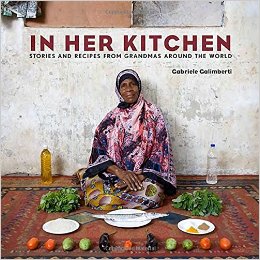
In Her Kitchen by Gabriele Galimberti


kitchenIs there anything better than food cooked by your grandma? Not likely, but the dishes you’ll find in this lovely book are not your typical Sunday gravy.

Galimberti shares a story early in the narrative about how his grandmother, who lived her entire life in the same small Italian village, was worried about what he would eat during a two-year assignment traveling the world. He realized then that he had an opportunity to explore the concepts of food and family by seeking out people just like his grandmother and looking for common ground. His journey begins with his grandmother, Marisa Batini of Castiglion Fiorentino Italy, and concludes with his mother, Paola Agnelli, a new grandmother herself. In between are the stories and recipes of women, of grandmothers, the world over.

We meet grandmothers from Brazil, Armenia, Canada, Alaska, Morocco, Albania, Mexico, Colombia, Thailand, Malta, Norway, Bolivia, India, Zambia, Fiji Islands, Japan, Sweden, Haiti, and many others. We meet grandmothers who cook over open fires and high-tech ranges, who have all the amenities of the modern world or no running water or electricity, who buy their food in a supermarket or hunt and kill it in the wild. The common thread that ties all these women together is the reason they cook, and it is always family. Grandmothers who cook for their children and grandchildren, whose task is to nourish the family and make them strong. We learn about favorite recipes that have been handed down in the families for generations, treasured plates and bowls that belonged to long dead grandmothers, food and ritual that has great meaning.

Galimberti’s format here gives great honor to the grandmothers. Lovely, full-page color photos of each grandmother in her kitchen or cooking space, followed by photos of the food and then the recipes makes this an easy, pleasant book to read. What lifts this above an ordinary book are Galimberti’s short essays about each grandmother, her country, her recipes, and her family. We learn about his experiences cooking with these women and how the project changed him and many ways. What comes through so clearly is the love in the households of these women. I have many favorites throughout the book, but one that spoke out loud to me is Natalie Bakradze of Tbilisi, Georgia, whose special recipe is Khinkali (traditional pork & beef dumplings). Her photo shows an ordinary woman wearing a mischievous, somewhat self-conscious smile, as though she is thinking “why is this boy taking my picture?” Galimberti’s essay about her says “Everybody in the family wears sweaters and scarves that she knitted for them, and everybody – including her daughter-in-law – brags that she is the best cook in town.”

The admiration, respect, and love shown these women is truly touching and heartwarming. They all welcomed Galimberti into their homes and kitchens, cooked with him, and shared their food – all extremely personal actions. He, in turn, has captured the universal essence of family and food in a readable, very accessible book.

Highly recommended.

Arts & Crafts

little book of BOOK MAKING by Charlotte Rivers


little bookThere are people who love to read and prize the story above all else. These people will read anything – traditional printed books, e-books, magazines, comic books, and so on. Then there are others who love the form of the book as much as the words. These people love the feel and smell and heft of a book. They appreciate the font used to create the words, the paper used to create the pages, the color used to create beautiful endpapers or illustrations, and the art of the cover. A book is a book is a book.

In the little book of BOOK MAKING by Charlotte Rivers, the art of creating a book is broken down into multiple types of processes that artists and crafters can use to create beautiful handmade books. Rivers begins by offering an “anatomy of a book” that illustrates and describes all the different parts of a book – signatures, endpapers, head- and tailbands, the case, covering, backing material, and spine. This simple illustration and accompanying text is useful for any beginning bookbinder and will be something a budding book artist will refer to again and again.

Rivers then introduces the reader to a number of accomplished book binders and artists from around the world. Their featured work illustrates types of book creation such as folded bindings and includes intricate work from artists like Gabriela Irigoyen, Thereza Rowe, and Becca Hirsbrunner among others. Each page features a different artist, including photos and descriptions of their work. The same descriptive process is followed for chapters on sewn bindings and packaging.

Rivers reserves the final chapter for “Bookmaking in Practice” where she gives the tools and steps needed to begin binding your own books. I nice set of illustrations and descriptions of necessary tools precedes instructions written by individual artists on how to make a variety of books, from an “Instant Book” to accordian, carousel, and dragon books. Also included are step by step instructions on various binding techniques such as pamphlet stitch, coptic stitch, long stitch, and Japanese stab stitch. Finally, instructions for creating a case binding, marbling endpapers, hand-dying paper, and creating cloth-covered boards are also included.

While the drawn, illustrated instructions might put some people off, they work in this little book. The instructions are clear, and using photos of real artist bound books to demonstrate different aspects of book making helps makes this a handy guide for anyone interested in trying book making.

Recommended for library collections and students.

Uncategorized

Reading Round-Up


Lately, I’ve been in a bit of a reading slump. You know how it is – you start a book, drift away from it, start something else, drift away…and so on. Nothing has gripped my attention lately, so I have re-read a few old favorites along with some odd little fluff, and some ARCs from Netgalley and Edleweiss. Here’s my round-up:

  • Book of Life by Deborah Harkness – This was the hotly anticipated conclusion to the All Souls trilogy. Unfortunately, it didn’t deliver. The storyline was bloated and felt extremely rushed, like Harkness and her publisher were so pressured to deliver the manuscript that they skipped the editing process. I found the main character, Diana, really irritating this time around, and the love triangle introduced at the end was ridiculous and unnecessary. Someone suggested I should go back and read all three books consecutively to see if that makes The Book of Life hold together. I may make that a summer reading project because I really did enjoy the first two installments in this series.
  • Call the Nurse by Mary MacLeod – This was a delightful, autobiographical treatment of the author’s time spent as a nurse on a remote Scottish island. The characters were not extremely well-developed, but were colorful and highly entertaining. After I finished this, I had an overwhelming desire to visit those Scottish islands. Google images is a wonderful thing for satisfying that kind of curiosity. Just saying….
  • The Secret of Greystone Hall by Elizabeth Wide, Cauldstane by Linda Gillard, and Secrets in Stone by Rebecca Engel were throwbacks to my early teen obsession with gothic mystery/romances. None of them were great literature, but all of them were fun.
  • Blood Faerie by India Drummond, Lord James Harrington by Lynn Florkiewicz, Station Eleven by Emily St. John Mandel, Faerie Tale by Raymond Feist, The Bookman’s Tale by Charlie Lovett,and Snow White Red-Handed by Maia Chance were all books I started and couldn’t finish. I know, I know – Station Eleven??? The book on everyone’s “Best of 2014?” Yep. I thought it was predictable and boring, but I am not a fan of dystopian, end-of-the-world-as-we-know-it stories anyway. Be truthful – how many of you who did read it and loved it didn’t see the big twist coming at the end?
  • Books that I have finished and need to write reviews: The Night Gardener by Jonathan Auxier, Monogram Murders by Sophie Hannah & Agatha Christie, The Supernatural Enhancements by Edgar Cantero, Vertigo 42 by Martha Grimes, Goodnight June by Sarah Jio, Stoker’s Manuscript by Royce Prouty, All the Lovely Bad Ones by Mary Downing Hahn, Winter at the Door by Sarah Graves (an excellent new mystery series set in Maine), House of Echoes by Brendan Duffy, Age of Miracles by Karen Thompson Walker, and As Chimney Sweepers Come to Dust by Allen Bradley.

Now, I just have to sit down and write the reviews!

Cookbooks

Go Fresh: A Heart Healthy Cookbook


American Heart Association Go Fresh: A Heart-Healthy Cookbook with Shopping and Storage TipsMy typical routine when reviewing books is to read them, then place them near my computer so I have them handy when writing the review (and so I *remember* to write the review!) In this case, I *did* forget to write the review because this book hasn’t left my kitchen! Go Fresh by the American Heart Association is packed with tasty, healthy, and easy recipes that can satisfy even the most reluctant healthy eater.

Beginning with short, easy to read sections on how to build healthy eating habits, this book includes everything from how to buy and store fresh foods, to kitchen & cooking tips, to lucid, straightforward advice on how to achieve a healthy lifestyle, to dozens of delicious recipes. I really appreciate a cookbook that is written in a simple, consistent style, and Go Fresh is definitely that. The recipe layout is uncluttered and includes clear, step by step directions. Boxes listing serving sizes, prep time, cook time, and standing time appear in the upper corners of each recipe page. In addition, there are numerous “Cook’s Tip” boxes throughout the book, offering useful advice for the novice to the experienced cook.

A center section of lovely, full-color photos adds a nice touch to the book. Every recipe I tried came out beautifully and all were well-received by my family. Some new favorites include: Parmesan-Spinach Soup, Citrus-Soy Tilapia, Espresso-Rubbed Flank Steak, and Broccolini with Toasted Walnuts. It was a special treat to have this book during the summer harvest season, when so much fresh food is available.

I have tried many, many healthy eating cookbooks over the years and always seem to come back to those from the AHA. There are no gimmicks, no strange foods that cost the earth, or special cooking utensils required here – just good, fresh food. I highly recommend this book.