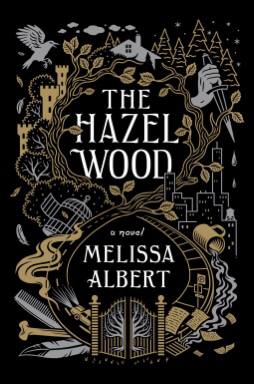
 Do you believe in fairytales? If you answered yes, do you think you could survive in a fairytale world? Alice Crewe knows nothing about the world of fairytales, called The Hinterland here, until her famous grandmother dies. Althea Proserpine wrote a mysterious, rare book of completely original tales after disappearing in the European woods for several years. All Alice knows about Althea is that she and her mother, Ella, have been running from her for years. But now she’s dead and everything changes. Ella disappears, Alice is being followed, and weird things are happening wherever Alice goes. She becomes focused on finding Ella, and the trail eventually leads her to Althea’s mysterious compound deep in the forests of upstate New York. There Alice discovers the true story behind her birth, her relationship with her mother, and her role in the Hinterland.
Everyone knows there is a dark side to fairytales, and Melissa Albert freely explores that darkness in a fresh and inventive manner in this debut novel. Albert has been writing for teens and an online audience for a long time, and that experience has resulted in a richly plotted, beautifully written, imaginative reboot of the fairytale world. What if the stories are real? What happens when the order of things is disrupted? What happens when the stories change? Alice definitely shakes things up when she gets into The Hinterland. She’s the clod in the churn, the pebble in the shoe, and she is most definitely *not* the “Alice” as written into the story ‘Alice-Three-Times.” At one point, when she is acting all contrary to the story, she says
“I did it because a girl doing nothing in a fairytale ends up dead or worse, but a girl who makes a decision usually gets a reward.”
Seems like a sensible choice to me!
Albert explores many themes here: people who use stories to escape from their real lives, people who manipulate others to affect the outcome of a story, people who challenge the status quo for love, people who *can* and *do* change. Alice and Ella are both flawed characters, but you end up loving them in spite of their flaws simply because they love each other so fiercely. The Hazel Wood is a little bit Beautiful Creatures meets The Matrix and is dead-on entertaining. Highly recommended.
Publication Date: January 30, 2018
Published by Flatiron Books
Thanks to NetGalley for the advanced copy.

 I fell in love with Eowyn Ivey’s work when I read her debut novel,
  David Tanis Market Cooking: Recipes & Revelations, Ingredient by Ingredient by David Tanis
 Brave Red, Smart Frog: A New Book of Old Tales by Emily Jenkins
 Uncommon Type by Tom Hanks
 Healthy Meal Prep by Stephanie Tornatore and Adam Bannon
 The concept of women’s power being rooted in magic has become a regular theme in recent fiction, and The Secret History of Witches adds to that growing genre. Louisa Morgan has created a captivating tale of six generations of Romani witches, women whose talents include “simples” like healing potions, knowledge of the weather, affinity for animals or growing things, and, most importantly, seeing the future.
 In the 19th century, the government of Canada, like the United States, began a systematic assault on Indigenous People. Land was confiscated. Rules and laws were established that controlled where and when Indigenous People could live, work, and travel. Perhaps the most insidious, disgusting action was the establishment of compulsory schools for Indigenous children, who were removed from their families, starved, abused, and indoctrinated into Christianity and the white way of life.
 Elizabeth Stuart (1596-1662), daughter of James VI, wife of Frederick V, known as the Winter Queen due to her single winter as Queen of Bohemia. Not a familiar queen to most, but an engaging subject in this entertaining piece of semi-historical fiction from Nicola Cornick which blends history, mystery, mysticism, and romance.
 Part mystery, part psychic adventure, part romance – The Fortune Teller has it all. The story opens with a death, that of Marcel Bossard, renowned collector of rare books and manuscripts. That disturbing scene is followed by our introduction to Semele Cavnow, an employee of the auction firm hired to sell the Bossard collection. As she begins her work, she feels an immediate, unusual attraction to Bossard’s son, Theo, which only intensifies as she spends more time in the Bossard home in Switzerland. Eventually, she finds a hidden book, very ancient and very mysterious, but not as mysterious as the handwritten note left in the book by Marcel Bossard, which is addressed specifically to her.
 It's All About the Book