
Biography, Historical, Young Adult

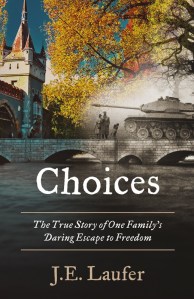
Choices by J.E. Laufer


IMG_0137The plight of refugees is all over the news these days, so Judit Laufer’s tale of her family’s escape from Communist Hungary is particularly relevant. Laufer, an accomplished author of children’s books, has done a remarkable job of taking the bones of a story she has heard her whole life, a story she lived as a very young child, and layering on flesh to create a suspenseful, emotional story of courage and compassion.

In 1956, Laufer’s mother Kati Krausz Egett was the lever that pried her family loose from the early days of Communist rule in Hungary. Shortly after the failed Hungarian Revolution, when hundreds of thousands fled, or were imprisoned or executed, the Egett family realized their only chance for keeping themselves and their children safe was to flee the country. The decision was particularly poignant because the Egett’s were Jewish. Kati survived Hitler’s concentration camps, while her entire family, and Adolf’s sister, perished in the gas chambers. The unimaginable tension and stress of the Communist takeover happening so soon after the end of WWII is palpable in the whispered conversation between Kati and Adolf early in the book, when Kati asks “What if our parents had left when the rumors started twelve years ago?”

Laufer recounts the family’s secret journey from their home to the Austrian border, where they were met by the Red Cross. They managed to get to Vienna, where they were taken in by the Just family. Eventually, the Egett’s made their way to Canada where they built a prosperous life for themselves and their children.

I get the sense that writing this story was something of a catharsis for Judit Egett Laufer, and she has done a fine job of conveying the fear and emotion that drove her parents’ decision to leave Hungary. The fear and uncertainty were overwhelmed by the need and desire to have a better life – a free life – for their children. Laufer’s story strikes a chord today, given the numbers of refugees fleeing oppressive regimes, and it reminds us that those refugees are people first. They have hopes and dreams, and a fierce desire for a better life.

In telling her own story, Laufer has given us a poignant, powerful reminder that human kindness and compassion is always the way. I’d highly recommend this for a high school social studies class, as well as for general reading.

General, Historical, Magical

The Library of Light & Shadow by MJ Rose


IMG_0110MJ Rose continues the La Lune series begun in Witch of Painted Sorrows with this story of Delphine Duplessi and her gift of painting people’s secrets. The pattern is familar to fans of the La Lune series – a passionate love affair gone wrong, a young artist struggling with her gift, and people who want to use her and her gift in nefarious ways.

We first meet Delphine in New York City, where she is engaged to a wealthy young man and is the current cause celebre at all the fabulous parties where she performs her “party trick” of drawing people’s secrets while blindfolded. That, you see, is her talent. Having been blinded at age 8, then her vision miraculously restored by her witch of a mother, she can see all the things people want to keep secret when she puts on a blindfold, or when she looks in a mirror. Her talent is a form of scrying and makes her constantly in demand at parties, until one night when the “party trick” reveals a dangerous secret that results in tragedy.

Shocked and numb, questioning her art and her purpose, Delphine slides into a deep depression, rescued only when her twin, Sebastien, arrives to take her home to France. Once there, Delphine continues to struggle with her art, refusing to put on the blindfold again in fear of creating more tragedy. At the same time, Sebastien, who is also Delphine’s manager, pushes her to put the blindfold back on and resume her work, specifically for Madame Calve, who wants Delphine to draw the secrets of her castle in order to find a valuable book hidden there for centuries. Underpinning all this is a failed and painful love affair, which is what initially sent Delphine to NYC. We learn about her passionate affair with Mathieu through entries in Delphine’s diary, all leading up to the two meeting face to face at Madame Calve’s.

Rose layers on more fascinating detail to the world of the Duplessi’s with each entry in this series, while still keeping some key elements common to each story. In addition, there are connections to and mentions of characters from Rose’s earlier books worked in throughout, which add a great deal to the world-building going on here.

My only issue is the pace of the storytelling, which is super slow for the first half, then very rushed at the end. For me, the best part of the story is what happens once Delphine and Sebastien get to Madame Calve’s, which doesn’t happen until halfway through the book. All the angst and self-pity Delphine experiences in the first half just bored me, as did her diary entries about Mathieu. Rose is known for incorporating some pretty steamy sex in her books, and that remains true here in the diary entries; however, I find it is getting repetitive and not adding much to the story. I wish there had been less of the first half and more of the second half of this book. I found the ending to be very rushed and would have liked to see a resolution between Delphine and Sebastien, given the surprising revelation that occurs near the end.

All that said, I continue to be fascinated with the world of the Duplessi’s and all who inhabit it. The story is, as always with Rose’s work, captivating. I expect the final entry in the La Lune series will focus on youngest sister, Jadine, who can read people’s tears. I look forward to it!

General, Romance

Readers of Broken Wheel Recommend by Katarina Bivald


IMG_0117The concept of this book strongly appealed to me: a young woman visits a dying midwestern town and revives it by opening a bookstore. To anyone other than a complete and utter Book Fool, this sounds….improbable-dull-ridiculous? To me, it sounds like love.

Sara Lindquist sets out from her home in Sweden (yes, that’s right. Sweden. The Country.)  to visit Amy Harris, a woman in Iowa with whom she has corresponded for a while. The two bonded over books, and Sara feels she knows Amy’s hometown of Broken Wheel, Iowa through Amy’s descriptions of the people and places there. For Sara, this is a huge step forward out of a quiet, unremarkable life as a bookstore employee. Sara’s anticipation of an entertaining visit talking with Amy about books is deflated upon her arrival when she discovers Amy has died. But then a remarkable thing happens. The town takes her in as Amy’s guest, just as though Amy were still alive. Sara comes to really know all the people Amy wrote about, and their stories, blended with the quiet desperation of a dying town, change course as they merge with Sara’s own story.

Truth be told, I nearly gave up on this book after the 100 pages. There wasn’t much happening and it just seemed incredibly sad. However, all the positive reviews this was getting kept me pushing through, and I am glad I persevered. The pace of the story remained slow through much of the book, but it accurately matched the pace of life in a town slowly fading away…until the last quarter of the book, that is, when everyone’s story seems to speed up and change.

The author uses Sara as a catalyst for change in this little town. Her arrival sets in motion a whole pattern of events that dramatically change the lives of several Broken Wheel residents. It’s as though Sara is Amy Harris’ parting gift to the people she loved, and that Broken Wheel is her gift to Sara.

This is a gentle, homey type of story that will appeal to book clubs, especially those in small towns. Bivald has captured some of the sadness and helplessness felt in Small Town America, but tempered that with the message that things can always change.

Ghosties, Young Adult

The Rattled Bones by S.M.Parker


IMG_0101I love a good ghost story, and this one has some pretty creepy, shivery moments. Combine those spine-tingling scenes with an interesting backstory and you’ve got a solid, satisfying read.
We meet our protagonist, Rilla Brae, as she’s still reeling from the sudden death of her father and coping with the life changes that accompany tragedy. Rilla, born and raised on the ocean helping her father fish for lobster off the coast of Maine, feels obligated to take on the family fishing grounds, which means giving up an academic scholarship to Brown University and staying in Maine. At the same time, she’s struggling with a changing relationship with her boyfriend and an absent, mentally ill mother. It’s a lot for anyone to handle, but Rilla meets the challenges head-on, with help from her Gram.

One day while out on the ocean, Rilla sees a young woman on a deserted island and hears an eerie song that calls to her. Haunted by her mother’s illness, where she claimed to hear and speak to the Water People, Rilla worries that she’s going mad. In an attempt to make her “girl” real, she explores the island where she first spotted the girl. There she meets Sam, a college student conducting an archaeological dig on the island looking for a lost community. Sam and the story of the island community help focus Rilla’s experiences as the ghost girl becomes more and more a part of Rilla’s life.

That period of time between high school and college is a time of change for most people. Rilla’s typical experiences are magnified by her father’s death, her sudden visual and auditory “hallucinations” of the girl, and a shocking revelation about an ugly period in the history of her community and family. Parker does a good job conveying the fear, excitement, guilt, and eagerness new high school graduates feel as they prepare to move on to new lives and new friends as they begin college. She successfully takes that universal story of growing up and pairs it with both a truly creepy ghost story and an interesting piece of history. Some of the ghostly parts were scary enough that I had to stop reading for a bit, especially after the scene where the ghost shows up in Rilla’s bed. The historical side to this story piqued my interest and prompted me to research the early island communities of the eastern seaboard. Fascinating stuff!

All in all, a satisfying story. Take this along on your summer vacation. You’ll thank me.

Magical, Romance

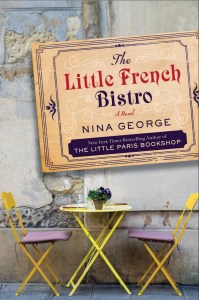
Little French Bistro by Nina George


Everything was more sacred than yourself, and your own longings were the least sacred thing of all.

IMG_0100This single sentence beautifully conveys the spirit of this gem of a story about a 60 year old woman who suddenly finds her life unbearable. When we first meet Marianne, she is readying herself to take a final plunge into the Seine in a desperate attempt to end her boring, insignificant life. Then we witness the first of many times Marianne’s life is saved, literally and figuratively, throughout the story.

That first “save” launches Marianne on a journey across France which begins as a quest to drown herself in the sea and ends with her figurative rebirth as a woman. Along the way, an incredible sequence of events, initiated by a painted tile of a seaside village, draws her closer and closer to Kerdruc, the lush and magical Breton village depicted on the tile. As Marianne journeys across France with nothing but a bit of cash and the clothes on her back, she reflects on the loveless marriage and cold-hearted, indifferent husband she’s running from, and begins to remember the girl she was before she was a wife.

When she reaches Kerdruc and finds the sea, she lands in the middle of a quaint village full of colorful, kind-hearted people who accept her at face-value. Their kindness and friendship begin to change her and reverse her wish to die. It is the sea, however, that gives her the strength to reject the old Marianne and let the real Marianne come forth and embrace her own magic and, ultimately, find love.

Nina George has once again created a world full of magical, quirky, witty, and human characters who live and love enthusiastically. There’s all sorts of love here – unrequited, rejected, deep and old, hidden, and raw. George’s Marianne is the catalyst that brings multiple love stories to their apex, while at the same time, creating a new story all her own. Marianne’s story is all too familiar – the middle-aged woman who suddenly realizes most of her life is gone and she has nothing to show for it. She has become a maid for her husband, invisible except when he wants something, unable to assert herself and fulfill her own needs, essentially voiceless. Under George’s care, Marianne comes alive in the pages of this story, and ultimately sees herself as other see her, through an artist’s eyes. I was reminded a bit of a book I read years ago – Praisesong for the Widow by Paule Marshall – as I accompanied Marianne on her journey. Like Avey, the protagonist of that book, Marianne connects with the land and people of Brittany, and especially with the sea, just as Avey connects with her African ancestors. Their journeys were similar and powerful, sending a message about how women sacrifice their lives for others, often living their lives through their families, and how there is always time to rediscover the young woman who once dreamed of a very different life.

Sometimes stories like this one leave me sad and unsatisfied. The Little French Bistro left me feeling joyful and hopeful, something we all need a bit more of these days. This would make an excellent book for a group discussion. Highly Recommended.

Mystery

Swiss Vendetta by Tracee de Hahn


swizz vendettaYou know the old adage “Never judge a book by its cover?” Well, it was far from top of mind when I spotted this beauty buried in the Mystery section at Barnes & Noble a few weeks ago. Hadn’t heard of the author. Wasn’t discounted. Set in Switzerland. But the cover! It called to me. So, I bought it.

What I found was a first-in-a-series, gently meandering but totally clever whodunit featuring the completely likable Inspector Agnes Luthi, charming aristocrat Julien Vallotton, and a cast of memorable characters.

We meet Agnes as she negotiates rapidly deteriorating roads, attempting to reach the grand Chateau Vallotton in the middle of the worst snow & ice storm Lausanne, Switzerland has seen in decades. The body of a young woman has been found outside the chateau, and Agnes is called to investigate her first case in the Violent Crimes Unit of the Lausanne Police Department. She manages to reach the chateau, where she finds herself snowed in with two fellow detectives, members of the Vallotton family, and assorted other characters, one of whom is most definitely a murderer. Even while she is neck deep in the murder, we find that Agnes is also wrestling with some personal tragedy. Her investigation becomes her own catharsis, leading to a very satisfying ending.

The author manages to weave Agnes’ personal tragedy into the story, so that the reader begins to know Agnes at the same time Agnes begins to know her suspects. Agnes herself is a welcome female protagonist, a professional woman who is also a mother trying to do the best she can and not always succeeding. This is one of those unusual mysteries that ride the rails between “cozy” and “hardboiled” detective fiction, which is a niche in which I will happily hide. In some ways, Agnes reminded me a bit of Martha Grimes’ Richard Jury, if that character had been female. I was delighted to find out that this is, indeed, the first in a series. The second in the series, A Well-Timed Murder, is scheduled for release in February 2018. Here’s hoping to finding an advanced reading copy!

Highly recommended.

Mystery

The Chalk Pit by Elly Griffiths


IMG_0097Anthropologist Ruth Galloway is back in the latest from Elly Griffiths, The Chalk Pit. As usual, there’s a lot going on in King’s Lynn.

This time, we find Ruth preparing to head underground to examine human remains uncovered during a routine soil sampling process. At the same time, Ruth’s quasi partner DCI Harry Nelson and his police squad are dealing with several incidents: a hungover student reporting a man who appeared and disappeared in front of her car in the middle of the night, a homeless man reporting the disappearance of a fellow street dweller, and a sink hole that suddenly opened in the middle of a busy road.

It’s typical of Griffiths to introduce several story strands in the first couple of chapters, so it’s no surprise when all of those stories come together into a single fat braid. Griffiths skillfully blends in well-researched pieces of history and interesting facts about the King’s Lynn-Norwich area to her books, with the Chalk Tunnels being the star here. The chalk mining tunnels take center stage, as Ruth searches for the answer to the human remains, which appear to have been boiled, while Nelson and his team pursue a villain who has kidnapped three women and “taken them underground.” Wrapping around all the mystery is the continuing unrequited relationship between Ruth and Nelson. Clearly they want to be with each other, but both have misgivings or other commitments. And, as if their already complicated personal situation wasn’t complex enough, Griffiths introduces two major life experiences here – a death and an impending birth. As usual, their relationship ups and downs drive the story forward.

This is the 9th entry in the Ruth Galloway series, and they just keep getting better. Very often, a series has a single focus – it’s a mystery, it’s a thriller, etc. – and the author excels at the genre, but isn’t always able to build a convincing world for their characters. Griffiths does that masterfully in the Galloway series. The mystery is a part of the world, something to be handled and managed and solved, but the core of the story is always the characters and their relationships with one another. While Ruth and Nelson are the apex characters, Griffiths has spent a good deal of time fleshing out the supporting characters, which makes them and their world real.

At the end of this, I am left impatiently waiting for the next entry, and pondering the question, “Who’s the father?” If you haven’t read the previous 8 books, go get them, binge read 1-9, and then grab up #10 as soon as it comes out.

Cookbooks

Holiday Cookies by Elisabet der Nederlanden


IMG_0091Those of you who know me, know I am a maniac when it comes to baking cookies for Christmas. My baking frenzy begins right after Halloween and, by mid-December all the freezers in my home are filled to the brim with dozens of varieties of cookies.
The rest of the year, I am on the look-out for new recipes, so I was happy to find this gem of a book through NetGalley. There are plenty of tips here for beginning bakers, covering baking, decorating, and storing cookies. The author divides the recipes into classics, cookies suitable for a cookie exchange, spiced cookies, cookies from around the world, cookies suitable for fancy decorating, and confections.

The recipes are simple and straightforward. If special equipment is required, it’s noted clearly. These are tasty, good-for-the-soul cookies that don’t require tons of special ingredients, equipment, or talent. The recipes are accompanied by tasteful and colorful photos of cookies that look like even a beginner could make them. The writing is warm and casual, inviting the reader to give the recipes a try without judgement. I thoroughly enjoyed reading through this and saved some recipes to try this year.

Recommended for all bakers.

Historical, Mystery

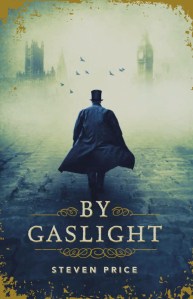
By Gaslight by Steven Price


IMG_0083When I requested this book from NetGalley, I vaguely thought it would somehow be about Jack the Ripper. What I found, though, was an intricate, unique, if somewhat wordy story revolving around William Pinkerton of the American Pinkerton Detectives and Swell Mob Prince Adam Foole. Pinkerton and Foole collide over the death of Charlotte Reckitt, one of them hunting her and one loving her. What begins as a seemingly simple story takes many twists and turns throughout to an ending that leaves room for a sequel.

Pinkerton has traveled to London to find Charlotte Reckitt, who he thinks has information about the mysterious Edward Shade, a man who apparently obsessed Pinkerton’s late father. Just as Pinkerton closes in on Reckitt, she jumps off a bridge. Days later, her mutilated body, minus its legs, shows up in pieces. At the same time, Foole returns to London from the U.S. after receiving a letter from Charlotte asking for his help. Despite her betrayal of him years before, he responds.

The story begins to get all twisty once Foole and Pinkerton have the same goal – find out who murdered Charlotte Reckitt. Betrayal, deceit, and loyalty all drive the major passions of this story, which neatly ties up all the loose ends around Charlotte Reckitt, Adam Foole, William Pinkerton, and Edward Shade. For now.

Price does a fine job of drawing compelling characters, and his story is fresh. I was reminded of Caleb Carr’s classic The Alienist a few times while reading this one. Pinkerton, while totally driven to catch the bad guys, is also smart and has a sensitive side. Foole, the slick con man, also has a conscience and loves deeply. The secondary characters, Molly and Fludd, are appealing for their devotion and loyalty to Foole. I want to read more stories about all of these characters! My only quibble with this was the length. As I was reading an Advanced Reading Copy, I expect there is room for some editing. My issue here, though, was only my impatience to get on with the story because it was so good. I do suggest that the reader keep a dictionary of 19th century slang handy, because there’s lots of it here.

By Gaslight is a fine entry into the 19th century crime fiction class, and Pinkerton & Foole have the potential to become a Holmes and Moriarty should the author choose to write more about them. I hope he does. Highly recommended.

Historical, Mystery

In This Grave Hour by Jacqueline Winspear


IMG_0082Winspear’s Maisie Dobbs series has been one of my go-to’s for years, both for my own reading and for recommending to others.

Until, however, the 11th entry.

A Dangerous Place completely put me off the series because of the horrifying (and, in my opinion, unnecessary) tragedy our heroine experienced right at the beginning. I can’t remember being so shocked at a twist in a series. So, I put Maisie away for awhile.

Then In This Grave Hour was published this year, and I thought I’d get reacquainted with the series. I found an older and wiser Maisie, to be sure, but also a woman who has experienced tremendous grief and is only just recovering some semblance of “normal” life. She has returned to London and restarted her detective agency with the ever trustworthy Billy. She has the means to live comfortably, and she does, even if alone and lonely. Then, England goes to war with Germany, which changes everything…and nothing.

Finding the mysterious Francesca Thomas in her garden late one afternoon, Maisie is once again plunged into a mystery. Thomas, a secretive and powerful attache with the Belgian Embassy, asks Maisie to investigate the death of a former Belgian refugee who was found executed outside his place of work. While Maisie takes the job, she knows that Thomas has not been entirely truthful with her. As Maisie delves deeper into the investigation, she uncovers a web of deceit stretching back to the First War. This part of the story seemed incidental to the bigger story of Maisie herself. The plot here was a little muddied and not terribly compelling. The real story here is Maisie.

While the Thomas investigation gives us the professional side of Maisie Dobbs, the declaration of war reveals the unsteady and somewhat raw personal side. Maisie must cope with the possibility of her beloved “nephews,” the offspring of best pal Priscilla, going off to war and never coming home. She is also drawn back to Surrey, where her father, stepmother, and mother-in-law are coping with children from London being resettled to the country. Maisie is particularly taken with a small girl who doesn’t speak and doesn’t seem to belong anywhere. Though both father and stepmother warn her not to get too attached to the child, Maisie can’t help herself.

In This Grave Hour is a watershed moment for Maisie. She has restored her career, she appears to have made as much peace as possible with her losses from A Dangerous Place, she is tentatively reconnecting with an old male friend, and I am predicting that the introduction of Anna, the displaced child, foreshadows a shift from Maisie the Student to Maisie the Teacher. She is slowly stepping into Maurice’s shoes (for those of you who haven’t read Maisie, Maurice was her mentor), bringing the series full circle. Winspear has won me back, and I am once again eagerly anticipating the next entry in the Maisie Dobbs series. Highly recommended.